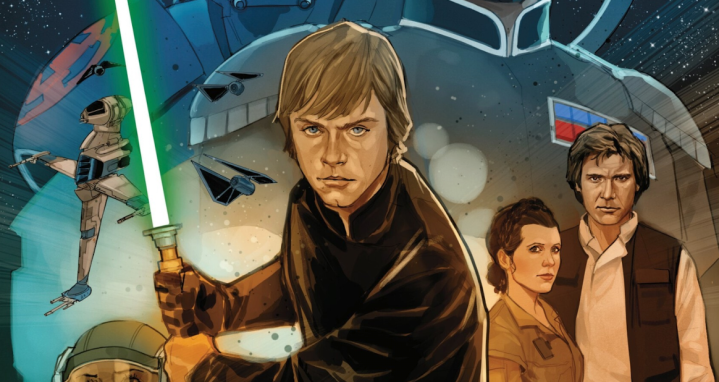
The Star Wars comics recently finished telling a very significant story in a key period of the timeline, exploring the lead-up to the Battle of Jakku and the fight itself, which marked the final battle of the Galactic Civil War, one year after the Battle of Endor turned the tide.
This story has been told in other formats, including the Aftermath book trilogy and the Battlefront II game, but now it’s been told in the comics too. It took place over three connecting mini-series, all written by Alex Segura. First was the four-part Insurgency Rising, then the four-part Republic Under Siege, and finally the four-part Last Stand. In general, it was a fine read; it was enjoyable and felt like an ‘important’ story being told, but it was also convoluted with some curious decisions.
Above all, it has made the storyline surrounding the Battle of Jakku far more confusing, even flat-out contradicting previous stories at times, while playing fast-and-loose with established canon. It does this in primarily three ways.
1. It creates confusion by needlessly muddying the water
There are a number of areas where the comic doesn’t directly contradict other stories, but creates far more confusion than is needed. Rather than trying to work this story within the other stories that have been told, the comic just went ahead and created other events that take place around the same time doing much the same thing. I’m sure some day there will be a harmony between these events as more gets fleshed out, which is why I don’t say it’s directly contradictory, but it is way too confusing.
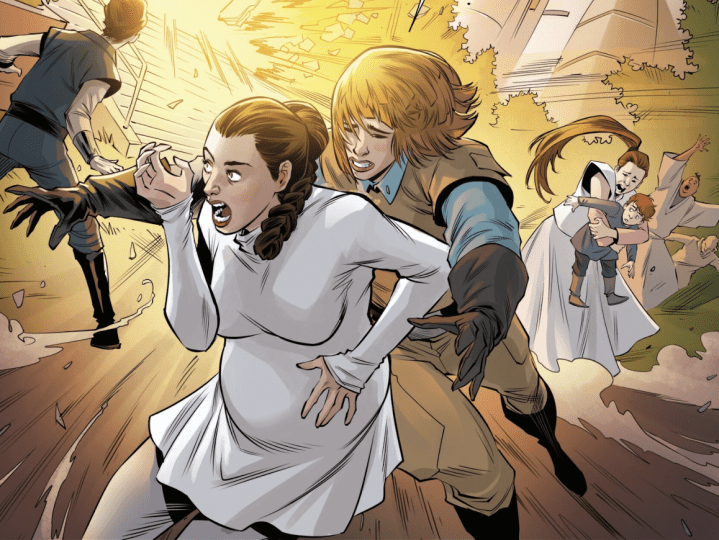
As one example, in Last Stand #1, an explosion on Chandrila was carried out by the Acolytes of the Beyond in an attempt to assassinate Senator Leia Organa. But this was actually the second assasination attempt on Chandrila in a very short amount of time. Not long before this event, there was a bombing on Chandrila that seriously injured New Republic Chancellor Mon Mothma and Imperial Grand Admiral Rae Sloane, killing several others (including General Crix Madine). Sloane had initiated peace talks with Mothma, but it was all a ruse to hide an attack planned by Gallius Rax – one that, unbeknownst to Sloane, was intended to kill even her.
This is something that the issue does reference, alluding to this happening so soon after “the chaos wrought by Sloane’s visit”. Because the issue acknowledges that other episode this isn’t directly contradictory, but it seems a bit confusing to have two separate bombings so close together on the same planet with a very similar purpose. By itself this would not be a big issue, but taken together with the rest of the series it just feels needlessly complex. Why did there need to be another bombing on Chandrila?
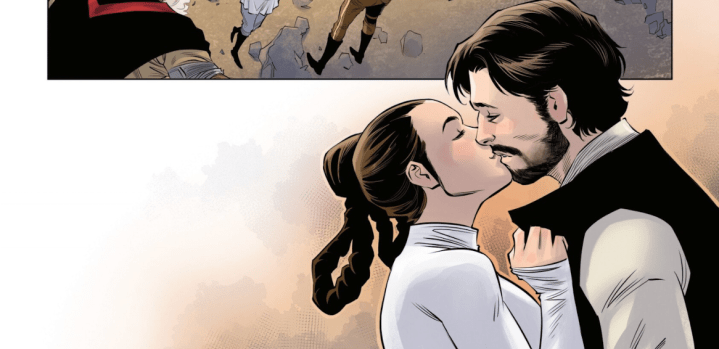
Let’s consider another example of this. The Battle of Jakku comics didn’t include Han Solo until the final part, because prior canon had already established that Han was on Kashyyyk with Chewbacca, fighting for the liberation of the Wookiee homeworld even though the New Republic didn’t have the resources to devote to it. This is something that Leia references in a conversation with Mon Mothma earlier in this comic series, struggling with the fact that the government wasn’t bringing aid to struggling planets. So on the one hand, this comic didn’t directly contradict prior stories. But it did, again, create further confusion rather than try to harmonize stories.
A major plot point of Aftermath: Life Debt deals with Leia having lost contact with her husband and sending a team to investigate. Learning that Han was in trouble in his fight against the Imperial remnants, Leia formed a covert mission, one unsanctioned by the New Republic. She flew the Millennium Falcon to encounter the Empire, and her allies soon arrived to provide reinforcements – including Fleet Admiral Gial Ackbar aboard Home One and Phantom Leader Wedge Antilles commanding his squadron. Kashyyyk was liberated thanks to these heroes, and Han and Leia were finally reunited. It’s one of the best stories to come out of the Aftermath books, and one of the best stories to come from this final year of the Civil War. No mention of that event is made in this comic, however, and the impression is given that Han abandoned his quest on Kashyyyk because Leia was in danger. It is, admittedly, a great story in its own right: in the aftermath of the Chandrila bombing (the second one), Leia is again in danger, but Han arrives just in time to shoot the invader and save his wife. Han and Leia, reunited again.
It’s an exciting moment, to have Han arrive to save his wife, just like it’s an exciting moment to have Leia arrive to save her husband. Ideally, both fit together well. And they probably will, once more gifted storytellers are able to weave these events into a more cohesive narrative. But in the comic, it directly states that Han leaves Chewbacca while they’re struggling to liberate Kashyyyk, which implies that this actually happens before the planet is finally freed. But if it happens before the planet is finally freed, then it basically makes it almost impossible to fit the other story from Aftermath into this timeline, given Han’s continued involvement with the heroes. In other words, the comic basically decided to create another reunion story for Han and Leia, meaning now we have two. Both of them are fun moments, but it’s just odd we have two of them. Again, needlessly confusing.
2. It creates complications by directly contradicting previous stories
While there are plenty of other ways this comic doesn’t flat-out contradict other stories but does make it especially confusing, let’s turn our attention to how the comic does directly contradict. This happens most egregiously with Grand Admiral Rae Sloane. On the one hand, telling any significant story of the Empire’s machinations during this time without Sloane would be futile, but on the other hand her story is already well-established and therefore there are already plenty of plot points established. Sloane was an Admiral in the Imperial Navy who pulled some of the Imperial remnants together after the Battle of Endor. Promoted to Grand Admiral and aligned with Gallius Rax, Sloane was the public face of these Imperial remnants. So far, the books and comics live in-sync.
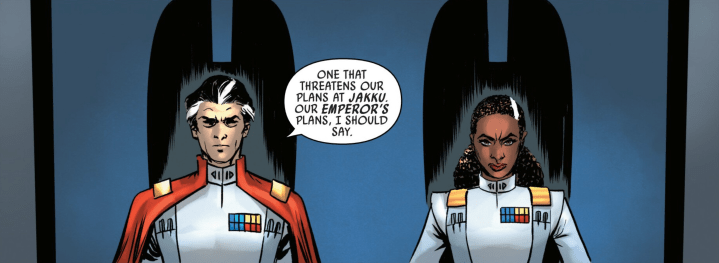
But they begin to diverge in a few crucial ways, mainly in regards to her partnership with Rax. As the Counselor to the Emperor, Rax was operating under orders from Palpatine to enact the Contingency, a plan the Emperor developed to ensure the Empire’s destruction should he die. In the Aftermath books, Sloane butts heads with Rax frequently, not knowing what he is really up to, and their relationship is forever fractured on Liberation Day – the occasion of the Chandrila bombing (the first one). Rax wanted Sloane dead to be rid of her, and Sloane later came to realize Rax’s full plans in this plot. From that point on, she hunted him down wanting to kill him, and on Jakku – during the Battle of Jakku – she finally realized Rax’s plans. She put an end to him by killing him, assuming control of the Imperial remnants fleeing into the Unknown Regions.
The comic, however, contradicts this in two main ways: first, Sloane is still present with Rax even after Liberation Day. Second, Sloane is aware of Rax’s plans for the Battle of Jakku and is aware of various factions being brought into play. Both of these things are explicit divergences from what came before. It leads to the same place – Sloane killing Rax on Jakku to assume control of the remnants – but it seems to come out of nowhere in the comic, since there was no set-up to it altogether (unlike in the Aftermath books). Rae Sloane is one of the most interesting characters to take a prominent role in this final year of the war, and it’s a shame what this comic did to her. It’s a storyline that many casual readers won’t have any knowledge of or issue with, but for those who have read the other stories, it’s a blatant disregard for past stories that greatly diminishes Sloane’s character.
Connected to this, there is also contradiction in regards to how the New Republic finds out about the Battle of Jakku. In this comic, they find out about it thanks to the Operator (Gallius Rax) telling them about it. But in the books, they found out about it from a few of their own agents bringing intel. It would not make sense for them to trust the Operator in the wake of the Liberation Day bombings, but the comic doesn’t care about that. This brings up a larger issue with these comics, and it’s that some of the major players in this story in the Aftermath books are hardly mentioned (sometimes not at all) in the comic, with some events like this one seeming to go out of its way to attribute happenings to other people. Like, for example, how the New Republic was lured to Jakku. The stories don’t match up.
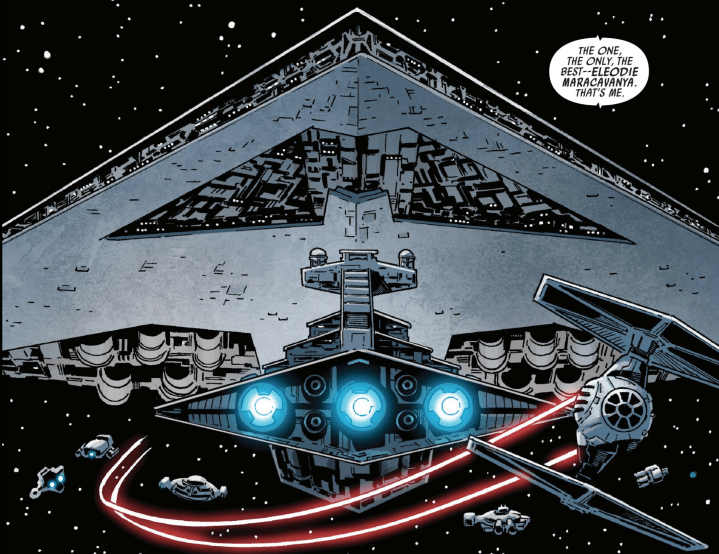
But even when some of those characters do appear, things still don’t match up – notably, with the pirate Eleodie Maracavanya. Eleodie led a crew of pirates who had control of the Super Star Destroyer Annihilator, which once belonged to General Tagge, and renamed it the Liberty’s Misrule. In a climactic moment of the comic, the Liberty’s Misrule arrives to attack Governor Adelhard’s forces. The moment doesn’t land like the author intended it since most readers won’t have any clue who Eleodie is and this is the first appearance in the comic. But it also really complicates things, because the Aftermath books explicitly state that the only Super Star Destroyer present at the Battle of Jakku was the Ravager, and explicitly state that the Liberty’s Misrule was not present – instead elsewhere in the galaxy hunting down fleeing Star Destroyers in an effort to curry favor with the New Republic. So we now have one story showing the Liberty’s Misrule showing up at the Battle of Jakku, and another story saying that the Liberty’s Misrule was not there. The Wookieepedia editors are going to have a real hard time sorting that one out.
3. It creates complacency by failing to add major moments to the story
So the Battle of Jakku plays very loose with the established canon that’s already been told regarding the Battle of Jakku. That could be forgivable, if the story this comic told was really exceptional. After all, the Aftermath books were met with very mixed reviews, including from myself. One of the big criticisms of the Aftermath books involved how in this crucial time period the original heroes were mostly sidelined doing other things, far away from the most significant of events (this is a larger discussion into how the books were marketed, written, and received, which is for another time). So this comic had the chance to be the definitive telling of the Battle of Jakku, since it shifted the focus onto Luke Skywalker, Leia Organa, Han Solo, and Lando Calrissian. If it did that in a particularly exciting and engaging way, it could easily have made up for the contradictions we’ve already covered.
It did not.
There were moments, sure. Moments where the original heroes really got a chance to shine. But in the end, the comic tried to have the heroes be involved more at Jakku without contradicting previous stories that didn’t have them there – which was always a mistake, in my opinion, and one that Star Wars is now kind of stuck with. So Alex Segura tried to include the heroes in the Battle of Jakku, and he did. Luke, Han, and Lando all made appearances at Jakku. But this all happened while basically giving these beloved heroes side-quests. It all centers around the threat posed by Governor Ubrik Adelhard, a villain who started out being interesting and became less and less so as the series went on. It seemed he was betrayed by someone every issue, yet without any serious stakes. He was seemingly killed once or twice, only to return. Let me put it this way: had Segura simply kept Adelhard dead when it seemed he had died, a number of these issues could have been prevented. Instead, Adelhard survived, and mounted a counter attack at Jakku on both the New Republic and the Empire, which muddied the water even more.
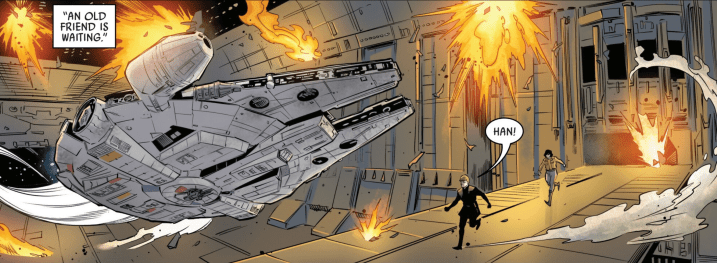
So, while the New Republic was planning for the grand finale battle of the War against the gathered Imperial Remnants, they decide that Luke Skywalker – a skilled fighter and a skilled pilot – should go look into the Spice Runners and Adelhard instead of being part of the Battle of Jakku. There were ways to include Luke in the Battle of Jakku that wouldn’t have contradicted previous stories – especially since some of those stories hinted at a rumored appearance from him anyway – but instead he arrives after a side-quest, just to focus on Adelhard. And it’s Luke’s focus on Adelhard that pulls Han and Lando into it.
In short, the Battle of Jakku comic contained plenty of contradictions: some that don’t directly counter previous stories but that make it confusing, and others that tell a clearly different story. All of this could have been overlooked by Star Wars fans if this comic had managed to do what previous stories had not – give the original heroes an important place in this pivotal story – but instead it gave us some mildly interesting side quests against an over-used and boring villain going in circles. If you’re looking for an enjoyable read without wanting to think too deeply into the timeline, Battle of Jakku is a fine choice. But those who read it wanting to develop a greater understanding of the Battle of Jakku, and all that led up to it, will come away greatly confused by the comic’s choices. It’s fun and enjoyable at times, but more often is rushed and disjointed, leaving a lot to be desired from Alex Segura’s highly-anticipated mini-series.

