When the first season of Star Wars: Visions was released in 2021, the episode “The Ninth Jedi” stood out among the rest – so much so that I wrote at the time that I hoped it would serve as the pilot to its own series.
Five years later, that series is here.
The eight-episode series Star Wars: Visions Presents – The Ninth Jedi has been released on Disney+, furthering the story begun in Visions Volume 1, and continued in Volume 3. The series comes from the creative mind of Kenji Kamiyama (The Lord of the Rings: The War of the Rohirrim) and is produced by Production I.G. in partnership with Lucasfilm. It’s a striking success, as the series is really well done and really enjoyable.
The Ninth Jedi is a non-canon story, which allows it to take more creative liberties with its storytelling (something seen in particular with how it approaches lightsabers). But that wouldn’t matter much anyway, because it is set far into the future from the stories we’ve become familiar with. At this time in the galaxy, the Jedi and the Sith are long gone – a thing of the past. Though there are still a few Jedi Masters in the galaxy attempting to train apprentices, there is no Order, and hasn’t been in a while. That means that lightsabers are an ancient relic, and importantly, the art of making lightsabers is a forgotten skill. There is only one who seems to remember how to do it: Lah Zhima. And that’s where the story picks up.
In the Volume One episode “The Ninth Jedi”, Zhima was kidnapped – leaving his daughter, Lah Kara, behind. She finds some surviving Jedi, and comes under the tutelage of Margrave Juro, who wants to rebuild the Jedi Order. When this series picks up, Kara, Juro, and their crew are searching for Zhima’s whereabouts, looking to reunite father and daughter. But Zhima is held captive by the villainous warlord Nawaam, who threatens the galaxy. In their travels, Kara and Juro meet other former Jedi (or former Jedi trainees) and attempt to recruit them, distributing some of Zhima’s lightsabers to them all. In classic storytelling fashion, these allies all wind up joining together by the end of the season to mount an attack against Nawaam’s forces. These characters don’t all get much of an arc, but they’re nonetheless really interesting characters.
In all of this The Ninth Jedi winds up doing a really admirable job of building a whole new galaxy. There are new planets, new aliens, new ship types – it’s all new. It feels like a fresh introduction to the galaxy, and it does feel like a brand new era. At the same time, it still feels like Star Wars, from the music to the visuals to the story beat (including yet another planet-killing weapon). Though there were parts of it that felt a little too similar to the rest of the franchise, overall I found it successful at establishing what is in essence a whole new galaxy.
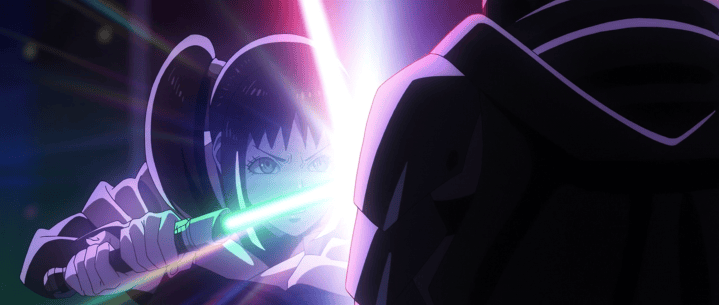
I also think that the anime format really allows the story to flourish, and that’s especially true with the lightsaber duels. There’s some really great battles and some really great lightsaber fights, and the over-the-top anime style is especially well-suited for this. Lightsabers play a key part of the story, so it’s a good thing that the lightsaber combat is exceptional.
Speaking of the lightsabers, one of the most interesting, and effective, story beats comes through these weapons. In the non-canon story, the lightsaber colors can change depending on the inner emotions and feelings of the character, which not only is an effective way of telling the viewer what state of mind a person is in, but also provides a narrative heart to The Ninth Jedi. Nawaam’s goal is to eliminate the Jedi and rule the galaxy, but his motivations aren’t the same as the Sith. Whereas the Sith tap into their anger and hatred, Nawaam’s goal is to achieve a state of nothingness, devoid of emotions and feelings – which is demonstrated by a silver lightsaber color. But is that the right way to go? In contrast to Nawaam is the heroic Kara, who goes through an inner journey in this series. Her green lightsaber shines as she fights, but in a moment of anger and fear, it turns red. She is horrified by this, but she comes to learn how to embrace this state of nothingness and have a silver saber. Yet, in the series’s crucial moments, she realizes that this isn’t the way and embraces the Jedi path, her saber returning to green, and she defeats Nawaam.
Though these lightsaber changes are non-canonical, the series provides a helpful step in the “gray Jedi” discussion. In recent years there has been a strange fascination by some Star Wars fans online about the idea of a gray Jedi, which isn’t really a thing, but has been raised by fans based on characters like Ahsoka Tano. The idea of a gray Jedi, as fans define it, is someone who embraces a middle road between the Jedi and Sith. But that’s not the way George Lucas envisioned the Force, the Jedi, or the Sith. “Balance” doesn’t mean a middle road. So I found it refreshing that this series didn’t treat the “silver saber” as the ideal, but actually a shortsighted and wrong approach from Nawaam (and others). Furthermore, this series shows that the real way to victory isn’t by embracing the dark side, nor by finding a middle “balance”, nor even by achieving a state of nothingness, but in embracing the ideals of the Jedi.
I found this to be a really helpful storytelling technique, but also a really compelling story. The ending is left open for future stories, and it seems that Nawaam might actually be the Ninth Jedi. There are future stories to be told about these attempts to bring back the Jedi Order, but those will be for another time. For now, I found The Ninth Jedi to be a terrific voyage into a new kind of Star Wars story. It’s a very enjoyable watch, and it’s something that I hope Lucasfilm pursues more of.

