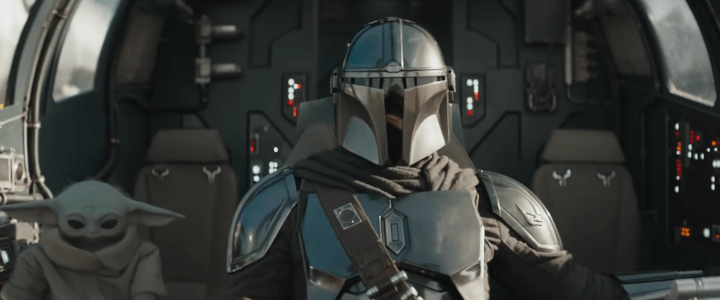
The Mandalorian and Grogu movie is a lot of fun. Grogu continues to be really adorable, while Mando continues to be really cool. But it is also becoming increasingly obvious that these stories are not interested in giving their main character a story arc any longer.
It has often been said that director Jon Favreau and Lucasfilm co-President Dave Filoni view these stories like they’re taking their action figures out of a box and playing with them, and I think it is an apt description. They are big on the fun and excitement, with lots of cool-looking characters and engaging action sequences. But, on the other hand, these stories are notoriously light on any kind of character development. Most of the supporting cast are one-dimensional characters. What is especially jarring, though, is that the Mandalorian is treated the same way.
That has not always been the case. When we first met him in season one he was a lone bounty hunter working various jobs, but upon meeting Grogu he had a change of heart and became the child’s protector. He was forced to change on the fly, a mercenary tasked with protecting for a child. He decides to take Grogu back to his own kind, and discovers that the Jedi could help. In season two, his quest to return Grogu to the Jedi also brings him into a crisis of identity. He meets other Mandalorians, like Bo-Katan Kryze, who freely remove their helmets. He is appalled by this, since his strict clan believes the creed to forbid it, but as the season goes on he not only befriends Bo-Katan, but also is forced to confront these beliefs. While infiltrating an Imperial compound trying to find out how to rescue Grogu he has to remove his helmet, a powerful moment that showed his care for the child. Then, upon rescuing Grogu and delivering him to Luke Skywalker, Mando removed his helmet to say goodbye to the kid.
What was unfolding was the potential for some really powerful storytelling: a lone bounty hunter who adopts a child to protect, and along the way is forced to confront his beliefs and realize that the way he has seen the galaxy isn’t the only way, or even the right way. It felt like his story was going somewhere.
But then in season three he felt the need to atone for his sin of taking off his helmet around others. We didn’t see his face. And this theme of his helmet needing left on continued into The Mandalorian and Grogu, too, where the Hutt twins have his helmet removed and tell him that he is now shamed. Which raises a few questions. First of all: how do the Twins know about this? Most Mandalorians have no problem removing their helmets. It seems rather convenient they know about this really strict sect, and believe them to be representative? Secondly, Mando tells them that he isn’t shamed as long as they all die, which seems like brand new information. They’re just making up rules now.
Now, let’s be honest: the real reason for these decisions are almost certainly because Pedro Pascal is rarely actually playing the Mandalorian. It’s easy to get away with this when the helmet stays on all the time, allowing Brendan Wayne and Lateef Crowder to play the character. It would be naive to ignore this reality.
Yet in-universe, it also is a decision that seems to have completely stalled any kind of growth for the character. In fact, a whole lot of season three and this movie feel like Favreau and Filoni reverting the character back to the beginning of season one and leaving him there.
- Nothing about Mando’s adventures in the first two seasons have done a single thing to alter his understanding of the Mandalorian way, except for him being less upset at other Mandalorians taking their helmets off. Has the goal been that he just becomes more understanding? Because the goal has certainly not been any deeper change. He is every bit as adamant that his helmet cannot be removed as he was at the beginning of the series, even though it’s been a major plot point all along.
- In this movie, he is given a new Razor Crest ship. It looks and feels just like his old one, just with a yellow paint job. His ship was destroyed in season two, but now he has a new one. No, not the new N1 starfighter he built in The Book of Boba Fett that signified to the audience that his bounty hunting days were over. Now it’s a brand new Razor Crest, as if nothing has changed.
- As the film approaches the final conflict, Mando finds a new pulse rifle and uses it to fight the Hutts and the Droid Gotra. He used an identical pulse rifle in the show’s first two seasons until it was destroyed aboard the Razor Crest. So don’t miss what is happening in this movie: now Mando is back flying a Razor Crest, wielding a pulse rifle. It is undeniable that this is a re-set for the character back to season one.
- Additionally, it is really curious that no one in The Mandalorian and Grogu ever utters his real name, Din Djarin. They created an entire two-hour movie where no one utters the hero’s real name. The Favreau and Filoni shows really don’t like using people’s names, so it’s not too surprising. But this is another piece of the puzzle that really makes it feel like this movie is trying to take the character back to season one.
- The best way for Djarin’s character arc to be seen is with Grogu, but even there, the movie sets up some big themes and fails to deliver on them. The idea of this being a story about a father and son is very compelling and is classic Star Wars. Grogu, at least, has been growing as the show has gone on, and that continues here. Yet the movie feels allergic to any kind of emotional intimacy between the two characters whatsoever. Though we’re supposed to be enamored by the father/son dynamic, Djarin at times speaks to Grogu like a pet, telling him to “heel”. It was probably intended for humor, but was a terrible choice. Most glaringly, though, after Grogu goes off on his own and cares for Djarin, nursing him back to health, the stage was set for a heartwarming exchange between the two of them. Instead, Djarin waxes Mandalorian poetry, saying, “The old protect the young and the young protect the old. This is the way.” Like, maybe “thank you” would have been the least he could say. There is almost no emotional chemistry between these two main characters on screen, and there hasn’t been much of it at all since the season two finale. The Favreau-and-Filoni-verse has also developed a reputation for not knowing how to have characters actually share any affection (anyone remember Ezra and Hera’s ‘reunion’ in Ahsoka?). Grogu wants this; the scene of him cuddling up in Djarin’s arms is very tender. But that kind of affection is entirely one-sided. Maybe that is by design, showing that Djarin still isn’t real comfortable in this new role. That’s fine, and could be an interesting dynamic to explore! But right now, it’s as if they want us to believe that he’s a good dad just because they’ve told us that, without showing it.
Don’t get me wrong: Din Djarin is a fun character who looks really cool and is an awesome action hero. But he hasn’t really been treated like an actual character in quite a while, and rather than changing that, The Mandalorian and Grogu intentionally reverted the developments we have seen. I hope that whatever is next for these characters dives more into their relationship than Favreau or Filoni have been willing to do recently.


Agree on all of this. It was a super-fun movie, but I think their story would have been better served as a season 4. I think Disney wanted a “safe” movie to blunt any risks Starfighter might be taking next year. I hope we still do get a season 4, but I doubt it now. And that’s a shame.
LikeLike