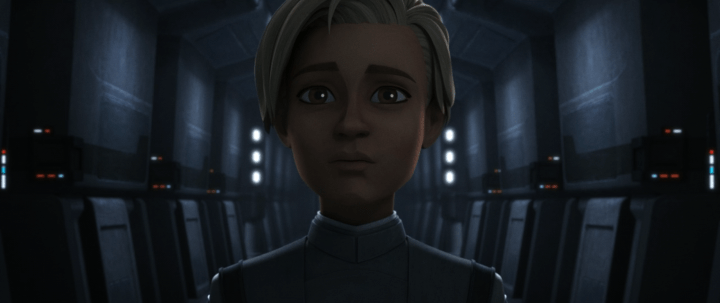
The Bad Batch is back! The third and final season of the animated series premiered this week on Disney+, with the first three episodes of the season dropping at once. And it didn’t take long for the series to jump full-on into the intrigue, telling a story that is quickly sprinting toward connecting all eras of the Star Wars films in some important ways.
Right from the start, it’s clear that this season is going to be an important story, a more serious and mature story as a successor to The Clone Wars, and one filled with emotion. Let’s dive in to the spoiler-filled review of the first three episodes – “Confined”, “Paths Unknown”, and “Shadows of Tantiss”.
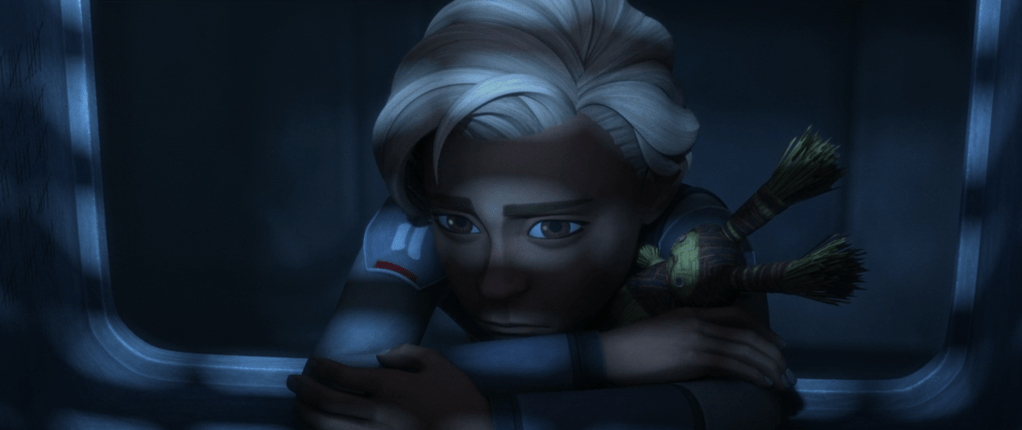
The season begins with Omega’s life on Mount Tantiss, and I’m so glad that the show is wasting no time on exploring Tantiss. After it was teased the first two seasons, we spend a lot of time on the planet already, with the first and third episodes taking place entirely on the fortress world. Omega feels like a prisoner even though she’s told she isn’t, and she goes about her days helping Nala Se in the lab and feeding creatures in the stable. Emory draws blood samples from clones, including Omega, but Nala Se discretely discards Omega’s sample each day. Many days pass – based on Omega’s markings it looks like over 150 have passed since she arrived – and her life stays mostly the same. She pays regular secret visits to Crosshair’s cell, telling him that though she’s working on a plan to escape she’s not leaving without him. He tells her to forget him and leave him behind, saying that he belongs there, but Omega says none of them do.
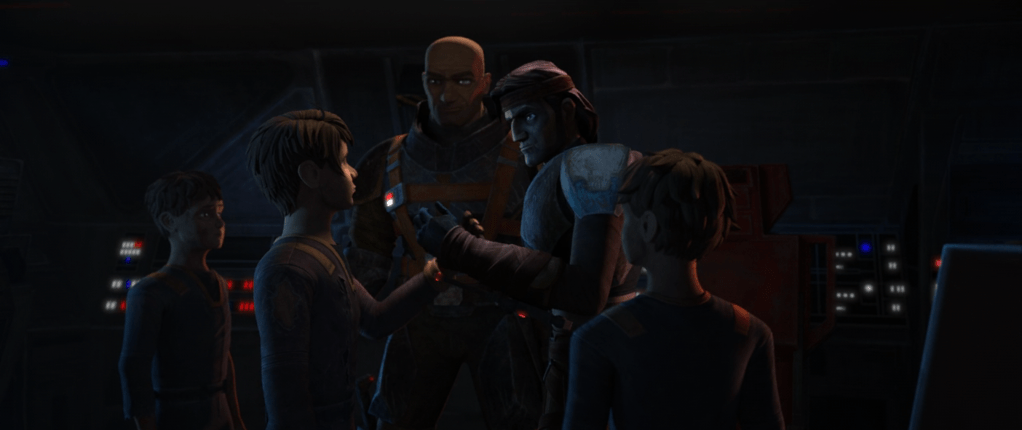
A major theme unfolding is that the Empire views the clones as dispensable and discards them whenever they stop being useful. But Omega shows that she’s not like them, refusing to leave Crosshair. Meanwhile, as episode two shows, Hunter and Wrecker refuse to leave Omega behind either. They run into a trio of regs, young cadets who escaped Imperial captivity from Doctor Hemlock’s previous lab. Two of the cadets contemplate leaving the others behind, but it’s the loyalty of Hunter and Wrecker that convinces them otherwise. Hunter promises to drop the cadets off on Pabu so that they have a chance to have a new life. The clones were bred as soldiers, but even without that purpose in the galaxy they have a right to exist and chart a new course. Hunter and Wrecker – alongside other clones like Rex and Echo – are taking a stand against the tyrannical Empire by staying loyal to their brothers (and sister), fighting so that the next generation can chart a new path in the galaxy.
All of this is illustrated in Omega’s relationship to a creature she names Batcher – a not-so-subtle nod to the Bad Batch. The creature serves a purpose to protect the fortress – as there are some dangerous threats beyond the walls, we learn – but Batcher is injured. The Empire thinks him expendable and prepares to kill him until Omega nurses him back to health. Even that doesn’t save him, however, as the Empire grows concerned about Batcher’s domestication and plans to terminate him nonetheless. Omega rebels and sets him free. All of this is a symbol of sort for the clones: they served a purpose but are viewed as expendable once that purpose is over, and as they grow to realize that there’s more than just being soldiers, the Empire wants to eradicate them. Omega – and her brothers – must take a stand to create a free galaxy for the clones, with a bright future ahead.
The central mystery of these episodes, though, as has been slowly teased over the first two seasons, is what the Empire is up to on Tantiss and what the deal is with Omega. Though we don’t get full answers, the third episode gives enough to set the course for the season and up the stakes considerably. The scientists are testing the clones blood for samples that can support a high M count – meaning a high midichlorian count – and there are test subjects kept in a top-secret vault visited by Hemlock and Nala Se. So far, though, no suitable transfers have been made. Emperor Palpatine pays a surprise visit to Tantiss to see the progress, and he says that Hemlock’s efforts are of utmost importance to the survival of the Empire. They journey to the vault, where Palpatine sees the progress and says that Hemlock will have whatever resources he needs to continue this Project Necromancer. Meanwhile, due to Palpatine’s arrival Nala Se is unable to destroy Omega’s blood sample and tells Omega that she must escape now, because once her blood is tested she’ll be in danger. Omega escapes, frees Crosshair, and together they break out of the fortress. Hemlock sends his troops after them, but the two clones work together to fend them off and steal a shuttle. Before the shuttle can be shot down, however, Emory informs Hemlock that Omega’s blood can support the high M count. Hemlock orders the pursuers to fall back, as they need Omega alive, and the two clones escape the system.
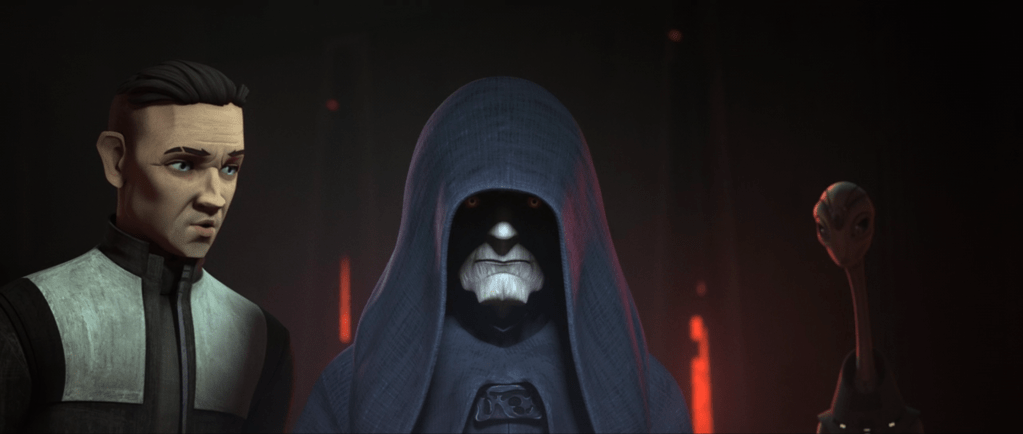
There are some major teases as to what is happening, and though we’ve been speculating as much for a while, it seems it’s fair to say it’s more than just speculation now. The Bad Batch is going to be directly tying into the sequel trilogy and The Mandalorian in some significant ways. The reference to an M count and Project Necromancer have both shown up in The Mandalorian as well, and Palpatine’s interest in the project and insistence of its importance to the Empire’s future makes this almost certainly connected to his obsession with trying to create a clone of himself. He’s been laying seeds of this for a while – such as in Revenge of the Sith telling Anakin that he could discover the secret to immortality – and it comes to fruition in the sequel trilogy. But the work hadn’t been quite successful, and there wasn’t a suitable host body for Palpatine. It meant that he was stuck on Exegol, while tests were run to find a suitable clone body that could support a high midichlorian count. Palpatine’s son, Dathan (Rey’s father), was one such test clone. Snoke was too. The Emperor is obsessed with preserving his own life, and the cloning efforts are toward this end.
And this is why Omega is so significant. Since the beginning of the series we’ve been wondering what exactly it is that makes her so valuable. We know what makes Hunter, Wrecker, Crosshair, and Tech different; but what about Omega? Many wondered if it was that she was Force-sensitive in ways that other clones weren’t. and while we don’t know whether that’s really the case, it seems that there’s the potential of midichlorians in her blood that make her perhaps the secret to creating a clone of Palpatine. All of the sudden, this story of a band of clones fighting to save one of their own turns into a story about them fighting – unknowingly – to save the galaxy. It would be very interesting if this series shows the Empire get ever-so-close to completing Project Necromancer, only to see their progress thwarted – leaving Palatine to flounder around on Exegol decades later.
These episodes are a fantastic start to the season, with the first and third ones being particularly strong. There’s an Andor-like feel and maturity to this season, and the stakes and intrigue are very high. It’s a dark time in the galaxy, and the potential for it to get darker lurks in the background as Palpatine tries to find the secret to immortality. All that stands in the way, it seems, is the loyalty of the clones in fighting for their family in standing up against an Empire that views them as expendable. This season is sure to be a thrilling ride, and it’s off to a tremendous start.
 Star Wars Thoughts
Excellent start to the season. I’m loving it already!
LikeLiked by 1 person