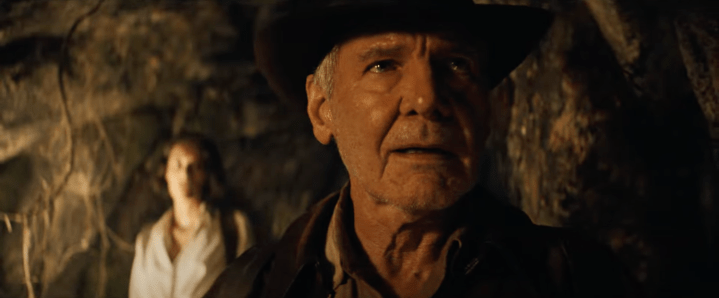
At long last, the premiere of Indiana Jones and the Dial of Destiny is nearly here. The film opens in theaters tomorrow, June 30, but opening night screenings are happening today.
To get you ready for the film, here are six things to know about it before you watch it.
1. This is Harrison Ford’s last time playing the iconic character
Harrison Ford is donning the fedora for a fifth – and final – time. Over four decades since first bringing one of the most iconic characters in movie history to life, Ford is saying goodbye. And unlike the humorous indifference he has shown to most of his roles, including Han Solo, over the years, it has always been clear that Ford loves the character of Indiana Jones deeply and takes great joy in playing him.
The future of the franchise is unclear. There had been rumors of Lucasfilm and Disney exploring a spin-off series, but that seems to have been shut down earlier this year. There are no current plans to continue the franchise, though anything is possible down the road. Regardless, this will be the last chapter for Harrison Ford.
2. Instead of viewing Indy’s age as a problem, the filmmakers leaned into it as a primary plot point
Part of the challenge for director James Mangold and the filmmaking team was what to do with an aging action-hero. Ford is 80, and his character is 70 at the time of the movie. It’s a challenge that Mangold not only accepted, but leaned into. He began thinking about what it would be like for an older Indiana Jones to be living in a very different world than he’s used to. “There’s this kind of dissonance,” Mangold says, “and what I thought is, ‘We should make that dissonance a character of the film.’”
Speaking with io9, Mangold elaborated that he thinks where Kingdom of the Crystal Skull went wrong was that it tried to treat it like a normal Indiana Jones adventure set in a different time, whereas what he believes is needed is to have Indiana Jones deal with trying to adjust to that different time. That’s where the idea for Dial of Destiny was born. “We should make the story about what it is to be a hero at sunset in his 70s in a world that no longer is necessarily looking toward the past, but is entirely looking toward the future,” he said. “In a world in which the heroes are rock stars or astronauts, not archeologists. In a world in which the division between good and evil is not so [obvious.]”
In a movie industry obsessed with youth and vitality and afraid of aging, Lucasfilm has been consistently unafraid to lean into what it’s like for a hero to grow older, to deal with a changing world and changing environment, and have to confront the pains of the past. Instead of pretending like everything’s normal with Indy, Mangold decided to lean into the fact that it’s not. So he came up with an idea: the movie begins with Indy in his prime, thanks to ILM’s de-aging technology, but then jumps to the present day in the timeline. The contrast between Indy in 1944 and 1969 will be shocking to viewers, but that’s by design. And, Mangold hopes, it leads to a satisfying payoff as the movie goes on and more and more of our familiar hero returns.
3. What was Indy up to when we last saw him?
We last saw Indiana Jones in 1957, twelve years before the events of this movie. As told in Kingdom of the Crystal Skull, Indy got pulled into a high-stakes quest to find a crystal skull with connections to aliens, with the Russians trying to claim the prize. It was through a young kid named Mutt Williams that Indy was brought into the mix, and that led to his reunion with Marion Ravenwood – where it was revealed that Mutt was their son. Years earlier Indy had left Marion shortly before their wedding, but unbeknownst to him she was pregnant. But now, with them together again, Indy and Marion re-kindled their old romance, and the movie ended with their wedding. From the looks of it in the trailers, however, the ensuing twelve years might not have been overly kind to Dr. Jones.
4. When does this movie take place?
The movie will open with a flashback to an Indiana Jones adventure set in 1944 during World War II (featuring a de-aged Harrison Ford), but will cut to the ‘present-day’ of the movie’s timeline, set in 1969. At that point our hero is 70 years old and nearing retirement, and the world has changed around him. 1969 was the year of the first moon landing, and the movie will deal with that at least in part, as the trailers showed a parade celebrating that event.
Mixed up in that, however, is a NASA scientist named Jürgen Voller (Mads Mikkelson), a Nazi scientist who helped put man on the moon. This is actually inspired by real life events; even though Voller is a character created for the film, NASA did enlist former Nazi scientists during the space race. Most notably was a man named Wernher von Braun, a Nazi aerospace engineer who developed rockets for Nazi Germany before later working with the United States to develop space rockets. Because of these connections it seems like the perfect way to bring Indiana Jones back in conflict with the Nazis, his old foe, as I can’t imagine he’d be too excited about them helping NASA.
5. What is the Dial of Archimedes?
The macguffin driving the film’s plot is the Dial of Archimedes, which is glimpsed in the trailer, and we hear Indiana Jones say he’s been looking for it his whole life. Voller is after it, as is Helena Shaw (Phoebe Waller-Bridge), Indy’s god-daughter. From there, like a typical Indiana Jones movie, it becomes a race between good and evil to get to it first.
The Dial of Archimedes, known as the Antikythera, is a real artifact. It was discovered in a shipwreck in 1901, and it is believed to have been used to track and predict astrological movements and eclipses. Though the origins of it are unknown (some think it was Archimedes who created it but no one knows for sure), and the use of it not clear either, what is obvious to everyone familiar with the device is that the technology is absolutely remarkable. It’s become known as the oldest analog computer ever invented, and there are no records of any other devices using such advanced technology until the 14th century – some 1,500 years or so after this dial was created. As such, it’s a technological marvel.
All Indiana Jones films include artifacts that are based in history, and the films then expand upon the legends in ways that go beyond history. Dial of Destiny will surely be no different. This dial is a real-life artifact, but the promotion of the film seems to hint at some time travel elements associated with it.
6. This is the first film not directed by Steven Spielberg – but he was still involved, as was George Lucas
Dial of Destiny is the first installment in the Indiana Jones film franchise not to be directed by the legendary Steven Spielberg, who was at the helm for the previous four movies. When development of a fifth Indiana Jones movie was announced way back in 2016, Spielberg was attached as director, but in 2020 he stepped down from the role, saying he wanted to pass the mantle to another. James Mangold was hired to replace Spielberg as director. Mangold is best-known for directing Logan (which earned him an Academy Award nomination for Best Adapted Screenplay) and Ford v. Ferrari (which was nominated for the Academy Award for Best Picture), and he also will be directing an upcoming Star Wars movie exploring the origins of the Jedi.
Spielberg, however, has remained involved on the project, serving as an executive producer. Also returning to the franchise as an executive producer is George Lucas, the creator of Indiana Jones; Dial of Destiny marks the first time Lucas has been credited for working on a project for Lucasfilm since selling the company in 2012 (he has consistently been given a “created by” credit, but not for any further involvement).
After he saw the movie, Spielberg reportedly turned around to the group he watched it with and said, “Damn! I thought I was the only one who knew how to make one of these.”
 Star Wars Thoughts