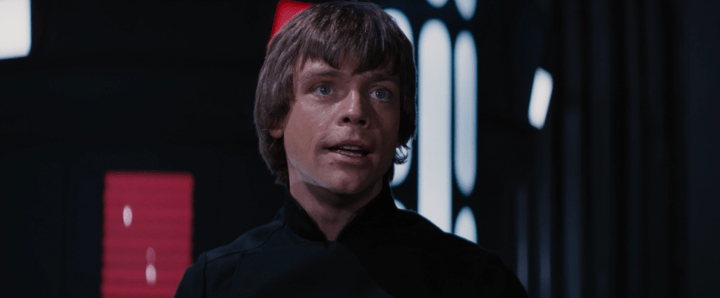
Return of the Jedi recently turned 40 years old, and I think it contains a moment that’s the most pivotal in the entire Star Wars franchise – not just at the time, but still to this day. And I dare say that, without properly understanding it, people will be prone to miss the deeper themes about the Jedi that George Lucas is trying to tell.
The scene I’m referring to is the final confrontation between Luke Skywalker and Darth Vader, which reaches it’s pinnacle at a surprising moment: when Luke throws away his lightsaber and refuses to fight any longer. This is the moment of our hero’s triumph, the moment where he finally declares “I am a Jedi, like my father before me.”
This moment shows what it means to be a Jedi, but the rest of the saga defines it. In A New Hope, we learned from Ben Kenobi that the Jedi were “the guardians of peace and justice in the galaxy.” That was their goal, their purpose. In The Empire Strikes Back, as Luke looks for a great warrior, Yoda responds, “oh? Wars not make one great.” One doesn’t become great by fighting. Later in that same film, Yoda tells him, “A Jedi uses the Force for knowledge and defense. Never for attack.” It becomes incredibly clear throughout the original trilogy that the Jedi are strongest not when attacking or fighting, but when defending life.
The same theme is established in the prequel trilogy. For example, in Attack of the Clones, Mace Windu tells Palpatine that, “we’re keepers of the peace, not soldiers.” Yet what happened in the prequels is that the Jedi were forced into a fight by a Sith Lord disguised as a Chancellor who was playing both sides. They had no business taking on the role of soldier, and yet they really had no other choice. Matthew Stover put it so eloquently in his masterful novelization of Revenge of the Sith, writing that, “The Clone Wars were the perfect Jedi trap. By fighting at all, the Jedi lost.” George Lucas was telling a subtle, yet subverted, story in the Star Wars franchise, one in which the hero draws closer to the darkness through fighting. The Jedi lost their way and fought a war.
And then, in the pinnacle moment of the original trilogy, Luke Skywalker stands on the brink of darkness. Yoda had already warned Luke – and, more importantly, the viewer – of this very thing earlier in the film. “Remember, a Jedi’s strength flows from the Force. But beware: anger, fear, aggression, the dark side are they. Once you start down the dark path, forever will it dominate your destiny. Luke, do not underestimate the powers of the Emperor, or suffer your father’s fate you will.” Yoda is foreshadowing the precise path to the dark side. This is a tactic that George Lucas uses elsewhere, to brilliant effect. For example, consider the trench run in A New Hope: before we even get to see it, there’s a clear description of what it should look like so that we know what to measure it by. So too with this movie, as we know the signs and symptoms to look for.
So, at the end of the film, Luke hides from Vader. He refuses to fight him. But then Vader threatens Leia, his sister, and something goes off inside the young Jedi. He ignites his lightsaber in a furious rage, spurred on by the fear of losing Leia. Anger? Check. Fear? Check. Aggression? Check. Luke is embracing the dark side, drawing ever nearer to the same fate his father fell into. Anakin feared loss and it consumed him. Will Luke repeat the same mistake? The stakes are set, Yoda’s warning rings in the back of our minds, and we’re left wondering: will the hero really fall? Again?
It’s at that moment that Luke stops himself. His rage has fueled him such that he easily overpowers Vader, slicing off his hand and doing away with his lightsaber. Vader lies helpless, while Palpatine goads Luke to kill him. But Luke stops, and he throws away his lightsaber. Why? Because that’s what a Jedi would do. A Jedi would stop giving in to fear, anger, and aggression, and instead choose not to fight. In this moment, Luke is sending a very clear message to Palpatine, the embodiment of all evil: I’d rather die than turn to the dark side. You can kill me, but you won’t turn me like you did my father.
This is Luke’s moment of triumph. And it visualizes what we’ve heard all along about what a Jedi really should be.
So then let’s fast-forward briefly to the sequel trilogy, and what do we find? In The Last Jedi we find Luke marching out to face down the whole First Order with nothing but a laser-sword. And through his actions, he halts the entire enemy army in its tracks and saves what’s left of the Resistance, all without so much as laying a finger on anyone. This is the most heroic, and truly Jedi-like act, that anyone has ever done, or that any of us have ever seen. Because this is what a Jedi is all about. Using the Force for knowledge and defense, but not for attack? Check. Being a guardian of peace and justice in the galaxy? Check. Doing so without becoming a bloodthirsty warrior in the process? Check.
Luke understands what it means to be a Jedi in a deep, profound way, and it’s highlighted in the subversive nature of the Star Wars saga. It finds it’s most ultimate moment, I’d argue, in Return of the Jedi, where we see Luke’s true victory as a Jedi.
 Star Wars Thoughts