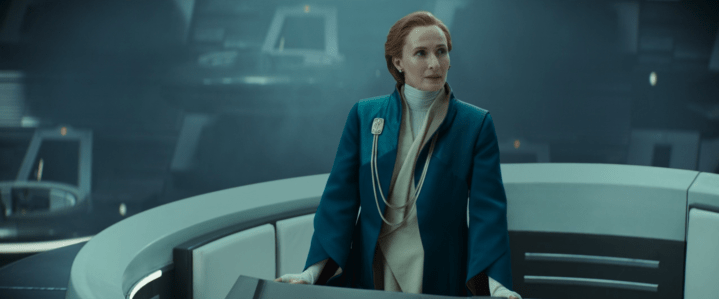
The moment we’ve been waiting for all season has come, and it was stunning.
The third arc of the second and final season of Andor has been slowly reaching a boiling point on Ghorman, and chaos erupted this week with the Ghorman Massacre finally unfolding – showing us the buildup, the event, and the fallout. It is, without question, some of the very best Star Wars material we’ve ever seen.
This show has always been fantastic, since the very beginning, but it has reached new heights with these three episodes, an arc that will stand among the best in the entire franchise. Let’s dive in to our review of thee episodes: “Messenger”, “Who Are You?”, and “Welcome to the Rebellion”.
A Rebellion that needs uniting
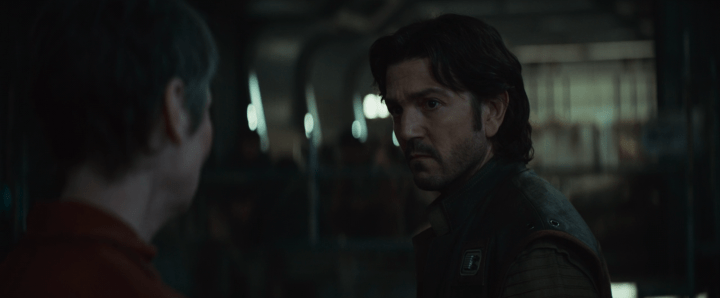
The episodes begin on Yavin IV, where the rebellion has already begun to establish their base at the Massassi Temple seen in A New Hope. General Draven is there, and so too is General Dodonna (though the latter is only mentioned, not seen). And Cassian Andor has settled down in a hut in the jungle with Bix Caleen. They’re still very much in the fight, but they’re part of this rebel cell on Yavin and don’t seem to be working for Luthen Rael that closely anymore. Wilmon still is working for Luthen, however, and he and Cassian get into an argument about Luthen. Cassian has clearly grown disillusioned with Luthen’s tactics. We saw that beginning to emerge last week, revolving around trying to protect Bix, but we also saw that he and Bix (as well as Vel and Cinta) are dissatisfied with Luthen’s desire to keep them mostly isolated from each other. Luthen thinks it’s easier and less messy that way, but it can only go so far. It’s no surprise that Cassian, Bix, and Vel are all now associated with this Yavin cell.
And it brings a very important reality to the forefront right near the beginning of this crucial arc, a reality that will become key: Cassian’s disagreement with Luthen pertains to his belief that the rebellion needs to join together instead of working individually. Cassian knows that there is something bigger, and that they need to band together to fight the Empire. Cassian has developed into the leader that Luthen was pushing him to be, but as a leader he recognizes that Luthen’s ideals can only take them so far. In order for them to win, they have to be together. That will hang over these episodes in the sense that these episodes are showing us the lead-up to Mon Mothma becoming the central leader who can and does organize the rebel cells into something bigger and better. Even judging by her conversations with Bail later, it seems Mothma is closely connected with the development of this Yavin cell. So we’re seeing the beginnings of this organized rebellion joining forces. So far Andor has been about various rebel factions disagreeing about how to fight while spending their time arguing with each other. Now, things are changing.
Staying with Cassian for a moment, he apparently suffered a bad blaster wound on his back shoulder that isn’t healing, so Bix arranges for a meeting with a Force healer on Yavin. I was really surprised to see this, as Andor has so far shied away from the mystical side of Star Wars and the Force, but it makes perfect sense. The Force is, after all, a key part of the galaxy, but it’s treated as a sort of spiritual, mystical reality in this episode, and Cassian doesn’t really know what to do with it. It’s a beautiful moment, with the healer simply amazed by the vision she had and telling him thank you. She says that he is the messenger, and thanks him for it. Cassian is confused by it, but we know what is meant: Cassian is the messenger, the one who will deliver the crucial message of the Death Star plans to the rebellion, and seeing as the destruction of the first Death Star was really the event that kick-started the war and more strongly united the rebel cells, Cassian will play a far more important role in this rebellion than he could ever imagine. That is the future the Force healer sensed, it’s one we know, and it makes the moment tragically beautiful.
But Cassian still hasn’t fully embraced his role as a rebel leader. Much to the chagrin of others, Cassian takes off with Wilmon, reluctantly heading to Ghorman to attempt to kill Dedra Meero, a person whom Cassian, Bix, and Wilmon all have a personal vendetta against.
The Ghorman Massacre

Ghorman has been central to the entire season’s plotline, and it all blew up this week. We’ve known that the Empire wants to mine the planet for the kalkite deep in its core for Krennic’s projects (a.k.a. the Death Star), but that doing so would so de-stabilize the planet that it would be uninhabitable. But the Ghorman people won’t just tolerate relocation, so Krennic takes Dedra’s advice: get the rebels to overplay their hand so that the Empire’s actions can be justified. Yet what we see in these episodes is that Dedra is struggling with the reality of the situation she’s helped to create.
The Empire being done taking it slow, the orders are given to tip the scales. They triggered some explosions and framed the Ghorman people for it, and in response, the people begin marching toward the square, shouting, “We are the Ghor! The galaxy is watching!” After they’re all assembled in the square, they begin singing an anthem of sorts, one that immediately evokes some of the songs of the French Revolution. It’s almost as if they’re saying, “do you hear the people sing?” It’s a peaceful protest, upset with the Empire’s overreach. The Ghormans, like the Empire, know that the galaxy is watching what is happening here – they just can’t expect what is next. Subtly, the Empire begins boxing the protestors in the square, blocking their exits.
The Empire’s whole plan is built around framing the Ghormans for being violent, which is why the Imperial officer sends his troops out into the square… where they are sitting ducks in the sight of a hidden Imperial sniper. The sniper shoots and kills an Imperial soldier, which causes the other Imperial soldiers to retaliate against what they presume to be a rebel attack, and the massacre ensues. It’s utterly harrowing, watching the Empire gun down the Ghorman people. They deploy stormtroopers, other ground forces, a sniper, and most formidable of all, K2 series droids who utterly demolish everything in their path.
This entire event was so masterfully done, slowly building up the powder keg only to light it on fire and watch it explode. And throughout it, we saw ordinary people of the galaxy rising up against the Empire’s tyranny – like the hotel employee who greets Cassian and secretly covers for him. This is the same man he met on an earlier trip, whose father was killed in the Tarkin Massacre years earlier. He too has joined this cause, doing his small part, and in it he leaves a legacy that reaches far beyond himself: he tells Cassian that “rebellions are built on hope.” Cassian himself will repeat that line in Rogue One to Jyn Erso, who will say it herself to the rebel council in a stirring speech. The people of the galaxy, rising up to resist the Empire, armed with nothing but hope. And the Empire, of course, is a tyrannical regime so bent on control that they’ll do anything to have it, thinking they can force the people into submission through lies and power.
“Who are you?”

The reality is that the Empire doesn’t care for their citizens, viewing them as only tools in their greater plans. Syril Karn is an obvious example of that, and he takes center stage in this eighth episode. He’s been working on Ghorman for a year-plus, aiding Dedra’s plans without knowing what they really are. But here, he begins to understand. He sees the Empire’s lies and how they orchestrated a bombing on their own facility to blame it on the insurgents. Syril feels betrayed and tries to help the Ghorman resistance see it, but he’s rebuffed as being with the ISB. I’m curious what exactly happened to so have this distrust between them, but it’s there. So Syril takes it up with his girlfriend, demanding to know what the Empire has really been doing. I predicted last week that Syril wouldn’t like being lied to and used like this, and sure enough, he’s furious.
Syril’s whole story has been trying to do justice. He wants to bring law and order. So, as a small-time Morlana officer, he took it upon himself to investigate the deaths of other officers. At the Imperial Bureau of Standards, Syril just kept trying to investigate crimes and bring justice. Working with Dedra for the ISB, Syril found purpose in helping the Empire enforce law and order. He’s done all of that, only to learn here that he’s been lied to. He’s a pawn. And the very people he so sought to be a part of, the very people he idolized, the very people he thought were going to bring justice, have been those perverting it. None of which, of course, excuses Syril’s actions. The signs have been there all along, and when someone willingly – and eagerly – submits themself to this kind of regime there is a level of culpability. But it is a sympathetic culpability, in that we see the Empire takes a person’s zeal and uses them. What can so easily, and subtly, happen is that a person who cares deeply for justice can buy into the promises of a government that promises law and order in order to bring about a “safe and secure society”. By stoking fear, a government can wield oppression, as people gladly trade freedoms for their own safety. Syril was a pawn in the Empire’s larger game.
And he realizes it, now. He wanders the crowds in Palmo Square, appearing overwhelmed, stunned, helpless. Until he sees a familiar face in the crowd, which stuns him even more. There, standing in front of him, is Cassian, looking to assassinate Dedra. Syril is overcome with anger and tackles Cassian, and the two get into a brutal fistfight. It ends with Syril standing over Cassian, gun in hand, ready to kill him. At which point Cassian asks, “who are you?” There could be nothing more devastating for Syril to hear in that moment than those three words, realizing that the man who has consumed his life for four years doesn’t even know him. The axe forgets, but the tree remembers, after all. Syril’s entire life changed when he investigated the deaths of two drunk Morlana officers whom Cassian had killed. Syril hunted down Cassian, only to be embarrassed on Ferrix. His life was ruined, his career in shambles, and he’s spent four years trying to rebuild it. The whole way, he’s been motivated by Andor, desperate to bring justice. Now, he’s got him within reach, and he realizes that Cassian doesn’t even know him. It’s a moment of realization for Syril. As actor Kyle Soller put it in an interview with The Hollywood Reporter, “He’s so desperate to be remembered and to make a difference, and it’s a cut too deep by that point. He’s been betrayed by Dedra and the Empire, and now his one true obsession doesn’t even think he’s worth remembering. He’s heartbroken.”
At this, Syril lowers the gun. What more is there to do? The man he’s been obsessed with finding doesn’t even know him. And then, in an instant, he’s unceremoniously killed by Carro Rylanz. Syril’s life is, really, a tragedy. Not because he did nothing wrong – he joined the Empire, after all – but because he didn’t understand just how he was being used and manipulated and betrayed all along the way, how the Empire took his ambition and twisted it. How he lost so much by his pursuit of Andor, only to realize it was worthless. Such is the tragedy of Syril Karn.
As showrunner Tony Gilroy explained to Entertainment Weekly,
“It’s so elementally Greek and dramatic that the thing that you’ve based your life on doesn’t even recognize you, Everything that he’s constructed for himself doesn’t even have any awareness of him. I think he’s just stunned. He can’t even breathe at that point. There’s the guy that ruined my life that I was chasing for four years, and I’ll be like this raccoon in a relentless fight, and I’ll be able to kill him. And then, oh my God, he doesn’t even know who I am! It seemed like the absolute essential summation of poor Syril’s life.”
Welcome to the Rebellion
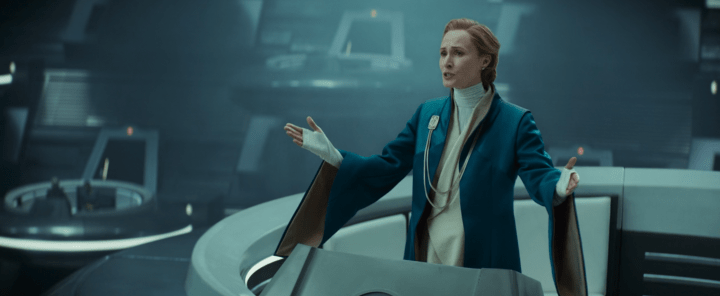
While Syril’s life comes to an end, the life of the rebellion is just beginning. The Ghorman people chanted that, “the galaxy is watching!”, and they’re right. The galaxy is watching what happens on Ghorman and taking note. Which leads us to the Imperial Senate, and a moment I’ve been eagerly waiting to see on-screen since season one. It’s a testament to Andor’s brilliance that the Ghorman Massacre can serve as part two of a three-part story, and the third part take place almost entirely in a Senate building yet feel like a fitting climax to the arc. This show is really, really good.
In the Senate, the Empire arrests the Ghorman senator, who earlier had told Mon Mothma that, “They don’t even bother to lie badly anymore. I suppose that’s the final humiliation.” One of the haunting aspects of this arc was how many journalists on Ghorman were repeating the Empire’s message, blaming the people of Ghorman for over-stepping and being hostile. The Empire knew they could control the message, and they did so in large part by influencing the press. It is a reminder that a crucial staple of a free society that stays anchored to reality is a free press, one not coerced or domineered by the state.
Aware of the Empire’s lies surrounding the events on Ghorman, Mothma knows that the time has come – the time that she long knew would come, now here. She speaks with Bail Organa about it, who tells her to go through with her plans to deliver a speech, telling her that Yavin needs her leadership. But he also tells her that they’re not ready enough yet for him to join her, and that he’ll stall in the Senate for another year. So Organa plans to stay behind, but help platform Mothma the next day in the Senate. The night is spent with great tension, and Mothma realizes just how alone she is.
First, he aide, Erskin Samaj, finds a listening device in her office (the ISB has bugged the senators’ offices). She knows she needs to work on the speech, but she also knows she can’t work on it while the Empire spies on her. Her office is not a safe place, and neither is her driver (an ISB plant). Second, while rehearsing it outside the Senate, Luthen Rael meets her and tells her that Erskin actually works for him. This is the ultimate betrayal, with Mothma later firing Erkin and telling him she’s never felt more betrayed. Third, Luthen tells her that Bail Organa’s people – the people who will get her to safety on Yavin after the speech – have been compromised. We can put the dots together on how he knows this: the agent infiltrating Bail’s group is an agent working for Jung, who works for Lonni at the ISB, who is a spy for Luthen. So now Mothma has been told that she can’t trust the people who are supposed to get her out. Only Luthen. But, fourth, she brings up Tay Kolma, her old friend whom Luthen had killed, and it’s as if she is asking him: how do I know you won’t kill me, now that I’ve become a vulnerability?
There is, in this moment, no one that Mon Mothma can trust. She’s all alone. Yet she proceeds with her plan to deliver a speech, because the galaxy needs it. The Empire’s lies need exposed, and Mothma needs to do it. She plans to walk into the Senate with no lightsaber, no blaster, and no real allies to trust to help her escape. All she takes with her are her words (the pen is mightier than the sword, after all), to wage war on Palpatine. It’s one of the great acts of heroism in Star Wars, and one I’m thrilled to see on-screen.
Organa craftily uses the Emperor’s own emergency declarations against him, using it as an excuse to platform Mothma without interruption. And that’s when Genevieve O’Reilly gets her own monologue, every bit as great as those we saw in season one. While the ISB tries to shut down the feed to keep her speech from being broadcast, Mothma delivers an impassioned plea to her colleagues – anyone who will listen, really – about the Empire’s atrocities.
“Fellow Senators, friends, colleagues, allies, adversaries: I stand before you this morning with a heavy heart. I’ve spent my life in this chamber. I came here as a child, and as I look around me now I realize I have almost no memories that pre-date my arrival, and few bonds of affection that cleave so tightly. Through these many years I believe I have served my constituents honorably and upheld our code of conduct. This chamber is a cauldron of opinions, and we’ve certainly all had our patience and tempers tested in pursuit of our ideals. Disagree as we might, I am hopeful that those of you who know me will vouch for my credibility in the days to come. I stand this morning with a difficult message. I believe we are in crisis. The distance between what is said and what is known to be true has become an abyss. Of all the things at risk, the loss of an objective reality is perhaps the most dangerous. The death of truth is the ultimate victory of evil. When truth leaves us, when we let it slip away, when it is ripped from our hands, we become vulnerable to the appetite of whatever monster screams the loudest. This chamber’s hold on the truth was finally lost on the Ghorman plaza. What took place yesterday, what happened yesterday on Ghorman, was unprovoked genocide! Yes! Genocide! And that truth has been exiled from this chamber! And the monster screaming the loudest? The monster we’ve helped create? The monster who will come for us all soon enough? Is Emperor Palpatine!”
The main emphasis of that speech revolves around what is true. The Empire’s message that the galaxy is buying is that they were just keeping law and order and that the people of Ghorman brought this upon themselves, but Mothma knows otherwise. So her going on the offensive is targeted at this most crucial of all matters: the truth. When a government lies and tries to suppress the truth, it will never go well. “The death of truth”, Mothma notes defiantly, “is the ultimate victory of evil.” The Empire wanted to rip truth from the hands of the people and replace it with their own narrative, a narrative determined by the fact that their voice would be louder than all others. And that might well be work, except for the fact that there are those like Mon Mothma who refuse to let it be so. As long as there are people who are willing to stand for what is true, no matter what the cost, evil will not ultimately be able to triumph. Truth is the greatest enemy of those whose deeds are evil, but it is the greatest ally of those who fight for justice. Mothma’s words could hardly be any more relevant for our day.
And with the speech, consider that Mothma’s resignation from the Senate, and the beginning of years spent on the run from the Empire as one of its most wanted enemies. Cassian helps her escape the Senate, killing the ISB plant (thanks to some help from Erskin) and then killing Kloris, her driver. These deaths horrify Mothma, who expresses doubt about whether she can do this. “Welcome to the rebellion”, Cassian tells her. Which, on one hand, ok, that’s kind of a dumb line, considering Mothma’s influence. She’s been in the fight longer than almost anyone, dating all the way back to those meetings with Bail, Padmé, and a few others during the final days of the Clone Wars. But of course, the line works so well because it’s showing Mothma’s transition. Up to this point she’s been rebelling mostly in secret, working behind-the-scenes to build a rebellion while putting on a front in the Imperial Senate. She’s been fighting in the halls of politics. But with this speech, Mothma has moved from the Senate to the frontlines. She is now getting to see the realities of war, the realities of rebellion, up close and personal. From this point on, she will be directly involved in the war effort.
The rebellion needs organizing, as Cassian knew, and that starts now. The characters in the show allude to Mothma preparing to give another speech, which actually ties in to Star Wars Rebels. As she is smuggled away from Coruscant the Empire continues to hunt her, so she winds up aboard the Ghost with Hera Syndulla and her band of rebels. They get her to safety above Dantooine, where Mothma broadcasts a message to rebel cells formally organizing the Rebel Alliance, and the rebels respond. The various rebel factions, who previously couldn’t agree, begin to join together under Mothma’s leadership. Her courageous resolve to call Ghorman what it was – genocide – and call out Emperor Palpatine for his evils stirred the rebellion into something more than it could have been without her.
The cost of rebellion

While Mothma is jumping more into the fight, Cassian is ready to get out of it. After witnessing the atrocities on Ghorman, he tells Luthen that he’ll help extract Mothma but will be done after that. Upon returning to Yavin IV he tells Bix the same thing, telling her that he’s made his decision and he wants to be with her. He’s ready to leave the rebellion behind, because all he wants is to be with her. It is at this point, unbeknownst to Cassian, that Bix makes the ultimate sacrifice: in the middle of the night, she leaves him. He awakes to a message recorded for him by Bix, who tells him:
My love. You’re sleeping now. You look so peaceful. I wanna be brave, but I can’t. If I was brave, I would stay and do this in person, but I know you, and you’d just talk me around, and I’ve been thinking about this too long to let that happen. I have to leave. I have to go away. I’m not sure where or for how long, I just know that I can’t stay here with you now. I believe what you said. It is a choice. It just can’t be me. I can’t be the reason you leave here. If you ever gave this up for me, I’d – I’d never forgive myself. We have to win. We have to beat them. And I believe you have purpose in making that happen. I need to believe that. So, I’m choosing for the both of us. I’m choosing the Rebellion. And when it’s done, when it’s over, and we’ve won, we can do all the things we ever wanted. Everything we’d know we’ve missed. I’ll find you.
It’s a heartbreaking emotional moment, and in a show full of them this one packs a particular punch. Accompanied by Brandon Roberts’ terrific score and scenes of Cassian, emotional, sprinting toward the base desperately hoping to find her before she leaves, this moment is poignant and tragic and hopeful all at the same time. Bix is making the hardest possible choice for the greater good of the rebellion, knowing that they need Cassian and that he has a destiny to play in this fight, and that if she stays he’ll give it all up for her. Though everything within her wants to be with him, she makes the choice to leave him so that the rebellion can prosper, and win. She’s in this fight, and she isn’t willing to see the cause suffer for her sake. She’s giving up everything in the fight.
And so too, of course, will Cassian. He’ll give his life to give the rebellion a spark of hope that will be fanned into a flame that will, in due time, burn the Empire down. The rebellion does need him, and he does have a destiny to fulfill. But the reason this moment is so heartbreaking is because we know. We know that Bix won’t find him, that they won’t get to share the future they dream of, that Cassian will never live to see the end of this fight. This casts the ending moments of Rogue One in a new light, as Cassian embraces Jyn Erso on the beach of Scarif watching their impending death approach. In those moments, he is surely thinking of Bix, and of the future they won’t get to share, but a future for the galaxy that they hope has been secured for the galaxy through their efforts.
A familiar face

Perhaps so that the episode doesn’t end on such a heartbreaking note, the arc ends with Cassian gaining a new friend. Shortly after Bix has left, Cassian is alerted that they’re about to activate the KX droid he stole. While on Ghorman, a KX droid pursued Cassian until he was crushed by a speeder, and Cassian decided to take the droid with him – making it obvious where the story was going for those familiar with Rogue One. Honestly this was the part of the arc that felt the most forced and the part that worked the least for me, because, well, why would Cassian bother to take a damaged KX droid with him at all as he tries to flee the massacre on Ghorman? Why would he even care about a KX droid at that point? It’s likely that he was thinking of the rebellion and thinking of how they could use such a formidable Imperial droid in their own service, but none of that is conveyed in the episode. He just gets an idea and takes the droid.
The real reason he takes the droid, of course, is that by the time of the movie he’s best friends with a KX droid named K-2SO, and this series had to explore how the two of them met. Which is a total retcon of the previously-established way of them meeting, which was shown in a comic. But honestly, I’m not overly bothered by that. And there are plenty of ways that this retcon could be fit together; a common theory I’ve seen suggested since the episode aired is that the rebellion doesn’t want to admit the droid was part of the Ghorman Massacre and therefore made up a cover story, which is what the comic goes over. That’s a perfectly believable explanation to me, and it’s just like the discrepancy of Cassian’s home world in season one was handled – with the previously-told answer being an in-universe cover for the real answer the show tells. That works fine in my mind!
So, at the end of the arc, they activate the droid, who is no longer hostile but friendly. And we know what will come next, with K-2SO and Cassian becoming friends and close allies. Though this part of the arc didn’t work as well for me, I’m incredibly excited to see K2 again next week.
Conclusion
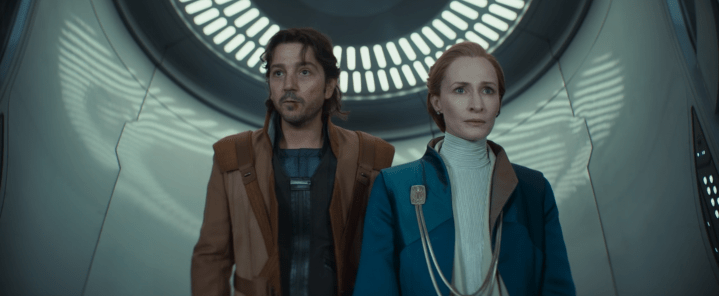
Overall, though, these three episodes – especially episodes 8 and 9 – are peak Star Wars. I don’t think it’s an overstatement to say that this is in rare air as some of the very best in the franchise, ever. That doesn’t mean we need to tear down other shows by comparison. It’s a beautiful thing that the same galaxy that can handle the mature elements like the Ghorman Massacre in Andor can handle fun, feel-good pirate adventures like Skeleton Crew. It’s possible to praise Andor for how good it is without hating on other Star Wars material.
But at the same time, let’s be clear: Andor is Star Wars at its very best. It’s a series that really shows how good the franchise can be and what Lucasfilm can do with a project that goes outside the box. It’s the rare Star Wars project that’s both enjoyed by fans and critically acclaimed by wider audiences, and that’s probably because the series is the most pointed fictional commentary currently on TV about our current age. Star Wars has always been about these themes, and has always been political, but this show is eerily prescient in how it handles it. I think Alex Damon, of the always excellent Star Wars Explained, said it perfectly in his review of these episodes: “Star Wars and its themes have not changed, but some of its audience stopped listening.”
Let’s listen once more to what the franchise is trying to teach us, about the nature of evil and the importance of truth, about the will and courage to fight for what is right. This show is Star Wars at its best, and these episodes will live on among the all-time greatest Star Wars projects ever made.
 Star Wars Thoughts