Any worry about whether the second season of Andor could capture the same heights as the first season can be safely set aside. As the final season of the show is now halfway over, it’s as good as ever and just keeps picking up speed. What Tony Gilroy and his team have created with this series is truly special.
That continued with the second arc of this second and final season, comprised of three episodes: “Ever Been to Ghorman?”, “I Have Friends Everywhere”, and “What a Festive Evening”. Disney and Lucasfilm made the decision to release the season with a new arc every week rather than simply one episode at a time, and though that sadly means the series will only run for four weeks the decision already seems to be a brilliant one, as it makes the viewing experience of each arc that much stronger.
Each arc is also designed to be one year apart, with the beginning of the arc marked off by the clanging of the Ferrix gong and a countdown, reminding us that we’re leading to the events of Rogue One. This week’s arc takes place three years prior to that, in 3 BBY (Before the Battle of Yavin), and it’s a brilliant bit of storytelling that sets up what is sure to be an explosive third arc next week.
Let’s dive in to the spoiler-filled review of these three episodes! As I did last week, I’m mostly going to follow these episodes through the storyline rather than episode-by-episode.
Going to Ghorman

One of the most significant things that we knew about this season of Andor well before it premiered was that we were going to Ghorman, and that was the most significant aspect of this week’s arc. And that’s a really big deal. It was mentioned in season one that the Empire was cracking down on their trade, and then last week we learned that Director Orson Krennic and the Empire have plans to mine for resources on the planet and displace the people, and he enlists Dedra Meero to help stir unrest until the rebels overplay their hand. We see that happening this week.
A lot of it centers around Syril Karn, who is delightfully awkward as always. He’s been transferred to run the Imperial Bureau of Standards office on Ghorman, which his mother thinks is a demotion. But unbeknownst to all but Dedra and Major Partagaz, Syril is a spy sent by the ISB to gain an ‘in’ with the underground Ghorman resistance. He does so through wiretapping his own conversations with his mother, and the Ghormans think that Syril’s having been fired by the ISB means he’s all the more sympathetic to them. Which is kinda hilarious, because of course you would think that, but Syril is a different kind of guy. His obsession with being important and being used by the ISB is all the more intense after his humiliation last season, not less.
After Syril gives a report to Martagaz on Coruscant and is praised for it, he tells Dedra that it’s the best day of his life. He’s just wanting to be important, and playing the role of the spy here is giving him a thrill. And his relationship with Dedra continues to be so wonderfully awkward, like when he goes to visit her, is seemingly impressed that she had him followed, and then she tells him to “turn out the lights”. Yet despite their relationship, it’s notable that Partagaz tells Dedra that she’s walking a fine line because even though they’ve brought Syril in, he can’t know what the Empire’s real purposes on Ghorman are. Because of this, I can’t help but wonder whether Syril could have a change of heart as the massacre begins to break out and he realizes that what he thought he was doing – and what his girlfriend had been telling him – wasn’t what he thought it was. It rarely turns out well when secrets like this are kept, and I’m sure there will be more to the story with them.
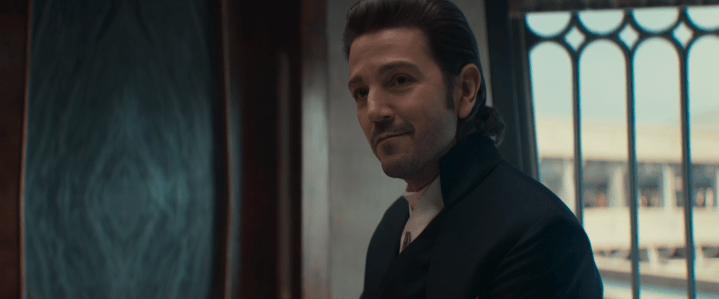
We know what most of the characters in the story don’t, and it’s the Empire’s true intentions on Ghorman, being to mine the planet, steal their resources, relocate the people, and force them to overplay their hand and demand an Imperial overreach. This arc slowly builds toward that, and at one point Luthen Rael sends Cassian Andor to the planet, disguised as a wealthy artist, to visit this resistance. It’s so great to see Cassian as a spy, as we remember that he was one of the rebellion’s “fulcrum” agents, meaning he was one of their most valuable spies in their large network. It’s really cool to see him in the element here, blending in and playing the part, all the while switching back and forth between the happy artist and the undercover spy. He gives the resistance some helpful insight, which shows that these people have the right impulse to fight the Empire but they don’t really know what they’re doing. They’re inexperienced, but eager – and those often go together.
But Cassian doesn’t think they should go through with their plan to hijack an Imperial transport, and that actually sets up a fascinating dilemma. We know that people have to rise up against the Empire and fight them, or else nothing is going to change. On the other hand, we also know that is exactly what Dedra and the Imperials are trying to set up. So Cassian is right in the sense that this plan will backfire, but Luthen isn’t wrong (at least, not completely) to think a strike needs to happen. This is part of the brilliance of Andor, of working out a scenario where there’s really no clear-cut obvious answer, because no matter what they do, the Empire is going to use it and win. That’s their plan on Ghorman, and we’ve only seen the beginning of it.
Those who aren’t as widely versed in Star Wars lore can easily follow along with this plot, but Ghorman is far more important than they may realize. These events are going to explore soon – next week – and the Empire will crack down. What will follow is the Ghorman Massacre, an event so horrific and tragic that Senator Mon Mothma will publicly decry Emperor Palpatine’s atrocities, resign from the Senate, and officially form the Alliance to Restore the Republic (aka the Rebel Alliance) – all the while she’s rushed to safety by her aides as the Empire tries to stop her. It’s the Ghorman Massacre that sparks this.
But this episode also teaches us that years earlier, in 19 BBY, Governor Wilhuff Tarkin led a massacre of the Ghormans, as 500 of them protested in the city square in Palmo, and Tarkin landed his ship right on top of them. As a young Ghorman man tells Cassian in the episode, no one thought someone would land a ship on civilians, yet Tarkin did it. That’s actually a direct nod to the Ghorman Massacre in Legends. We had long assumed that this event was no longer canon, since Rebels moved the timeline of the massacre to 2 BBY. But what Andor has done is re-canonize Tarkin’s Ghorman Massacre – and make it so that there will be two of them. It makes sense, too, as the monument honoring those who were killed in the attack is a target of Imperial overreach, which infuriates the citizens.
Tragedy on Ghorman
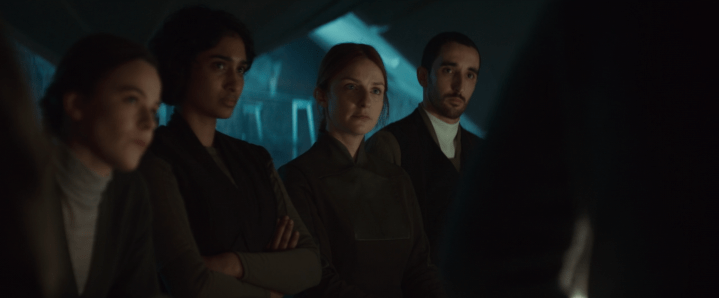
Before we move on from the Ghorman plot line, we need to visit the resistance’ plot that they do wind up carrying out. Cassian doesn’t want to be a part of it, so Luthen sends in others: Vel Sartha and Cinta Kaz. They’re there to help this inexperienced resistance pull off the heist, but not before they reunite. They meet up in a cafe and the impression is given that they haven’t seen each other in quite a while, perhaps even since the events on Ferrix last season. On top of that, Cinta reveals that she had an accident and has spent a considerable amount of time recovering – perhaps the accident came when she killed Tay Kolma? Like, maybe she crashed the speeder to make it look like an accident and was injured during it?
However the injuries came about, two things emerge from it. First, Vel is offended that Cinta didn’t tell her anything, and that Luthen didn’t tell her either. It further clarifies that Luthen doesn’t really want them together, as he thinks of them as mostly assets in his rebellion that are stronger without their attachments and connections (more on that in a bit). Second, Cinta says that during her recovery she had time to think about what matters, and she wants to rekindle her relationship with Vel. We see them share quiet moments together, kissing and reuniting, before the mission.
Once the mission gets underway, it all goes according to plan at first. Vel and Cinta had told the rebels that they shouldn’t bring blasters, as they wouldn’t be needed, and they will all make a clean getaway. Yet one of the rebels brought a blaster, and another one of the citizens of Palmo who isn’t in on the plan approaches wanting to know more. This leads to a shot accidentally being fired – which strikes and kills Cinta. Vel is devastated, and as the rebels drive away, she lights into the young man who fired the shot, who himself is devastated and in tears.
It’s a heartbreaking death because it just feels so random, and so pointless. In a way, just like Brasso’s death last week. Gunned down off-screen, by a blaster bolt, in a way that wasn’t at all part of some larger sacrifice for the rebellion or part of some heroic final stand. No, both Brasso and Cinta are just killed, and that’s it. It’s pointless! And when I say that, I don’t mean that Tony Gilroy’s story, or Beau Willimon’s writing, is bad; I mean that the whole point of their writing is to make these deaths feel pointless. It’s making us feel the sting and the pain of rebellion, helping us to realize just how costly the fight is.
And how much people have to give up for the cause.
Are attachments forbidden?

All of which really ties into one of the arc’s other major storylines, with Cassian and Bix. I love that these episodes really slow down enough to show us Cassian and Bix’s relationship, as they live in a safehouse on Coruscant. They go about their daily life – seeing a grocery store on Coruscant is fun, as well as the talk show “Good Morning Coruscant” – and are clearly in love, but they’re also hurting. Especially Bix, who has become hooked on drugs. She claims to Luthen that it’s to help her sleep amidst the nightmares, but it seems like she’s relying on them for more than just sleep. Beyond the drugs, Bix is also haunted by a recent mission that she and Cassian were on where Cassian killed a boy who was with them – all because this boy saw her face. Cassian, in other words, killed him because he was fearful about what could happen to Bix and wanted to protect her, but Bix didn’t think he needed to do it. Her PTSD and trauma is staggering, and it’s heartbreaking.
And Cassian wants nothing more than to protect her. He killed this boy because he saw her face. He doesn’t want to be seen out-and-about on Coruscant. He doesn’t want Bix coming on missions with him. He’s furious that Luthen visited her behind his back, without telling him, with the thought of giving her a mission. Luthen seems to think of this connection as a problem, a liability, something holding him back, but is it? The theme of attachments is nothing new to Star Wars – we saw it plenty during the prequel trilogy with the ethos of the Jedi famously forbidding attachments. Yet the real problem with attachments, in the Jedi point of view, was not caring about people (remember what Anakin said about Jedi being able to love) but being controlled by the fear of loss. Yoda warns Anakin that the fear of loss is a path to the dark side, and indeed it’s the very path that Anakin takes in becoming Darth Vader. He fears losing Padme, and his incessant need for control to try to keep her from death winds up corrupting everything else in his path.
So in this way, Cassian is in fact in danger. Being controlled by this fear won’t lead anywhere good. And perhaps that’s the direction Bix is trying to push him when she calls him out for killing the boy for simply seeing her face. She demands that she be a part of this fight too, and she knows that Cassian can’t compromise on these things just to try to keep her safe. On the other hand, Cassian is not wrong to value this relationship above others, and to refuse to sacrifice it on the altar of the rebellion. Though Luthen tries to push him away from Bix, just like Luthen tries to keep Vel and Cinta distant, Cassian refuses to take the bait. He knows that this relationship matters, and is worth fighting for. All of this brings up another Star Wars theme, with is that it matters why you’re fighting. Luthen’s fight is needed, but it seems largely driven by a hatred for the Empire and a desire to see them gone – at whatever cost. But Cassian here recognizes that if they’re not going to fight for the very people oppressed by the Empire, then what’s the point? It reminds us of the words of Rose Tico in The Last Jedi: “That’s how we’re gonna win. Not fighting what we hate. Saving what we love.”
Threads unraveling

Luthen doesn’t understand that. And, in this arc, things look to be unraveling a bit for him. He’s clearly overwhelmed by how many threads he and Kleya have out there, and by Kleya’s own admission, Luthen is slipping. He’s becoming more careless. And for all his noble intentions, things are backfiring on him. Like, for example, when Cassian storms into Luthen’s shop, breaking all protocol, to confront him over trying to enlist Bix. We could debate whether Cassian was right or wrong for handling it that way, but it has to show us that Luthen’s firm grip on this secrecy is beginning to backfire on him. Cassian, Bix, Vel, and Cinta are all coming to realize in this arc that though Luthen is trying to keep them distant, they need each other.
I think these episodes are showing us, more than we have seen before, the stress beginning to catch up with Luthen. But there’s still Kleya there to help, and she is taking on more and more responsibilities in this whole rebel network. A key point of this arc revolves around Kleya learning that Davo Sculden knows one of his artifacts is fake and is going to ship them off, where he will find a listening device hidden in it, that will trace back to Luthen and Kleya. All of which Kleya learned thanks to the listening device. So they hatch a plan to get the device out during a party that is thrown, a party that includes many senators – such as Mon Mothma. Luthen gives some high-ranking Imperials a tour of this private collection of artifacts, and here we get some gloriously good scenes between Mothma and Krennic as they try to maintain a respectable veneer but take veiled jabs at each other. It’s great.
While Luthen shows them around, Kleya enlists Lonni’s help (very reluctantly) to help her get the device out of the object, all while in plan sight of the Imperials. This is happening simultaneously with the heist on Ghorman, and it made for truly compelling moments where the tension had me on the edge of my seat, desperate to see what would happen. She wound up getting the device out, but one can’t help but wonder how stable Luthen’s whole operation is going to be moving forward.
A Silenced Senate

I mentioned Mon Mothma, and though her role in these episodes was less than last week (and, I’m guessing, less than next week), we still got a great montage of her trying to rally support for a bill in the Imperial Senate and getting nowhere. She’s trying to aid the Ghormans, but she can’t even get the Ghorman representatives to help because they don’t want to upset Palpatine. The Senate has become mostly pointless, concerned more with power and influence and posturing than actually governing. There’s a moment of new senators being sworn in, and Genevieve O’Reilly so perfectly captures Mothma’s tension. There is an evident love and admiration for this tradition, as well as a displeasure and anger over the mockery it’s become. The Senate is bogged down in parties and power grabbing, and Mothma is growing more and more exasperated with it.
At one of the parties, the one where she’ll encounter Krennic, her and Perrin meet Bail Organa on his way out. And here’s where the elephant in the room, long rumored, must be addressed. He’s played in this episode by Benjamin Bratt, who replaces Jimmy Smits – who brought Organa to live in the prequel trilogy, Rogue One, and most recently, Obi-Wan Kenobi. It’s a real bummer to not have Smits returning, which is because of scheduling conflicts in filming. I really wish they could have figured out a way to include Smits in the show, and I think this will make it somewhat awkward going from the prequels (with Smits) to Obi-Wan (with Smits) to Andor (with Bratt) to Rogue One (with Smits). This isn’t like someone playing a younger or older version of a character; this is an example of two actors now playing the character interchangeably in the timeline. And I’m bummed about that. However, since scheduling was a conflict, this seems like a necessity. It’s better to recast than to use the CGI technology to have Bail Organa in the show, and it would be impossible – and disappointing – to not include Bail Organa in a show about the formation of the rebellion. So, although it’s a bummer, this does seem to be the best way forward, and Bratt will do a great job, I’m sure. Gilroy introduced Bail in this brief scene here so that audiences won’t be taken aback by the change when Organa has a bigger role next week.
Radical Rebels with Rhydonium
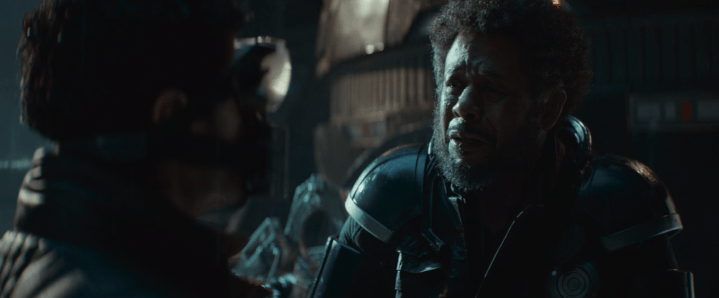
The final main plot thread to mention was one of the very best, and it followed Saw Gerrera and his band of rebels. Their base (for the moment) is on D’Qar, which first appeared in The Force Awakens as the Resistance base in the sequel trilogy. That’s a fun connection, since we had known that the Resistance base was housed in an old rebel facility. While at this base, Gerrera’s forces are visited by Wilmon, who brought a dispensary of rhydonium and plans to teach them how to use it before leaving.
Rhydonium was used as fuel for ships, but it was known for being extremely unstable and dangerous. And as this episode alluded to, its fumes were quite toxic for humans. But it seems Saw is addicted to it, and has learned to tolerate it. He explains to Wilmon that as a child on Onderon he was forced to harvest this gas, which was so toxic that it burned their clothes away and affected their bodies. He even goes so far as to call rhydonium his sister – which, for those who remember his sister from The Clone Wars, is a reminder of just how much he’s suffered for the cause. And he’s gotten hooked on rhydonium as a result… and this probably explains the breathing tube he relies on in Rogue One.
All of this leads to Saw giving an impassioned speech to Wilmon about how rebellion isn’t for the sane, about how they’ll all be dead before they see the Republic return and yet they’re still ready to fight. It’s a really fitting picture of Saw’s character, leading us up to where we find him in Rogue One. Star Wars has presented him as an unstable revolutionary, one who is fighting for the right things but doing so in a way that makes even the others uncomfortable. As Jyn Erso learns, the more established rebellion – led by Mothma – is wary of Gerrera’s radical tactics. And, ultimately, we know that Saw’s methods aren’t the best and won’t be the ones that prevail in the fight. But he’s aware of that here. He knows that he’s a bit crazy and insane. He knows it. Yet after all he suffered growing up, and all the hardships he’s endured, what else is there for him? He’s left to lose his mind, and take down the Empire in the process. And his passion for this and stirring speech is enough to convert Wilmon, and enough to show us why he’s a sympathetic – albeit at times misguided in his methods – leader and rebel.
Closing Thoughts

These episodes were terrific, and this is one of the best arcs of the whole series so far, in my opinion. With all of that said, the ending was a bit abrupt and jarring. Bix surprises Doctor Gorst in his new office, and she ties him down and forces him to listen to the same tape he played for her. She leaves, killing a guard, and is joined by Cassian, who presses a button and blows Gorst’s office up. It’s all played really fast, and it’s a bit too fast for my liking.
I do think it’s very fitting that while Bix can’t stop having nightmares about him, he can’t even remember her. Remember what season one taught us about how the axe forgets but the tree remembers? Such is the case with Bix and Gorst, an example of how the Empire doesn’t care – but how the pain they cause can’t be forgotten.
But the mission just seemed like a strange way to conclude these episodes. It seems that this is a mission Luthen sent Bix and Cassian on, probably in an attempt to give Bix a bit of comfort in getting revenge. And Luthen surely found out about Gorst’s new headquarters from Lonni, who might now be in danger if the Empire can deduce where the leak came from? That’s my point, I guess: we just don’t know much at all about what went down. One moment Bix is there with him, and that’s that. It works, and it’s satisfying, but it’s just a bit of a strange way to end it.
All in all, though, I loved these episodes, and I really can’t wait for next week when things on Ghorman reach their breaking point.
 Star Wars Thoughts