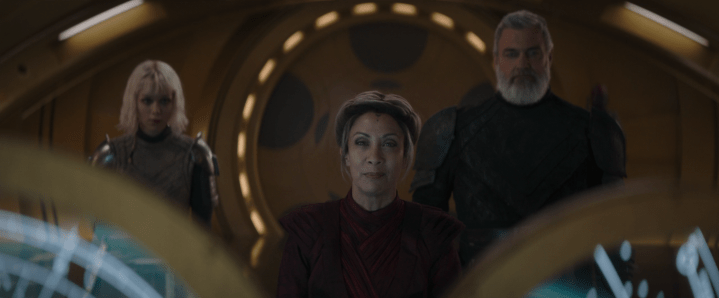
Ahsoka just keeps getting better and better, and episode 6 expanded the Star Wars universe in some massive ways.
It was parts familiar and parts totally new, but it’s all setting up some massive events that could alter the fate of galaxies. And with just two episodes left in the season, there are numerous threads that begin to grow a lot more intriguing in light of this week’s events.
Let’s dive in to the episode, but as always, be warned that full spoilers are ahead!
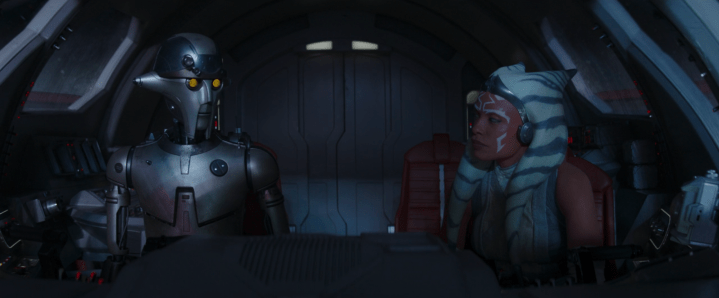
For a show titled Ahsoka, we get very little of Ahsoka Tano in this episode, but what we do get is important and sets the stage for the rest of it. We see her in the opening moments and not again, but the ending of the episode makes it clear that will change next week. Yet in this opening scene, as Ahsoka and Huyang travel to another galaxy in search of Sabine, Ahsoka confesses to Huyang that Sabine went willingly. She clearly struggles with this, and she blames herself for not having enough time to prepare Sabine to make the right choice. But it’s Huyang who pushes back on this idea, suggesting that it might have been Sabine’s only choice. Here an important theme is developed, one that will have ramifications throughout the episode: Sabine’s choice set all of this in motion – but that doesn’t necessarily mean it was wrong. Ahsoka says, “She could have ended this. No Thrawn. No war.” To which Huyang then adds, “And no Ezra.” Ahsoka thinks Sabine’s choice was selfish, but I think it actually raises an important question: should a Jedi be driven primarily by trying to stop a villain or by trying to save a friend? Ahsoka seems conflicted; she’s upset that Sabine made the choice she did, yet at the end of last week’s episode Ahsoka too seemed more motivated by finding Sabine than stopping Thrawn. To fight against evil is good, and necessary, for the sake of the galaxy. Sometimes that will mean making the hard choices. And sometimes those hard choices mean saying goodbye and choosing to let go – just like Ezra did, when he made the decisions he did at the Battle of Lothal to remove himself from the picture. Yet at the same time, the motivation for the fight can’t just be hatred of evil, or fear of darkness, but love of something brighter, something pure, something undefiled by the rising cloud: friendship, and a desire for a better galaxy for those you care about.
Sabine’s motivations are mixed. But she’s not wrong to want to find her friend. The goal of the Jedi shouldn’t be to never form attachments. After all, that’s part of how they went astray before, and Anakin even admitted that compassion – which he defined as unconditional love – is central to what being a Jedi is all about. What the Jedi forbid was a possessive form of attachment that clouded their vision and kept them from doing what was right, which, tragically, was Anakin’s very fate. I don’t think it’s a coincidence that we got the scenes with Anakin that we did right after Sabine made her choice. It’s one that has ramifications throughout this episode, and I’m guessing will continue to have ramifications – and, if I had to guess, she will be faced with another choice this season similar to the one she already was confronted with.
That was one aspect to this opening that set the stage, but there was another. Ahsoka reminisces about the stories that Huyang told in the Jedi Temple, about the history of the galaxy, and Huyang begins telling her one, starting with, “a long time ago, in a galaxy far, far away…” It’s a bit on the nose, and the first time those famous words have ever been said on-screen in Star Wars, but it fits perfectly naturally here. It sets the stage for the episode, though, by highlighting that we’re navigating the territory of legends, stories, myths. Baylan Skoll and Shin Hati pick up on that later, which is part of the mystery of this episode. But a lot of it is set up right from the start.

From there, though, the episode really gets going, as the villains arrive in a brand new galaxy at Peridia (which has some very clear Middle Earth and Minas Tirith vibes from The Lord of the Rings). And the planet is haunting: from the purrgil graveyard orbiting the planet to the ancient, desolate, empty vibes given off on the surface, it’s a perfect setting for the events that are happening. And, very importantly, we learn that it was actually the ancient homeworld of the Nightsisters of Dathomir. The group of witches apparently were among the first to use the purrgil to travel to the new galaxy, and it’s a great bit of lore that really expands some of what we thought we knew. It seems the Nightsisters will play a key role in some of the upcoming stories, and it turns out that the three Nightsisters, the Great Mothers, were the ones calling to Morgan Elsbeth. Their names are listed in the credits as Aktropaw, Klothow, and Lakesis. That might seem rather inconsequential… but Dave Filoni often pulls from all sorts of mythology. In Greek Mythology, the Moirai (or the Fates) were three sisters who controlled destiny and fate. Their names? Atropos, Clotho, and Lachesis. That doesn’t seem like a coincidence. Especially since their role in this episode seems to be dealing a lot with fate as well, and the threads of destiny that are unfolding. Now consider again the conversation between Ahsoka and Huyang at the beginning, and Ahsoka told him, “[Sabine] was fated to make that choice.” What’s unfolding in this episode is the events of fate, both with Sabine’s choice and with Thrawn’s resurgence. The destiny of the galaxy lies in the balance.
And speaking of Thrawn, I have delayed long enough to talk about it, but the Grand Admiral is back, and for the first time ever in live-action. For those unfamiliar with him, he first appeared in the book Heir to the Empire in 1991, which was a massively influential story in the Star Wars franchise and fandom. The book was the first time that we really thought there could be more stories after Return of the Jedi, and the basic storyline saw Thrawn return as the last remaining Grand Admiral in the post-Endor period to wage war on the New Republic in an effort to restore the Empire. Sound familiar? Though that old Thrawn trilogy is no longer considered canon, it’s clearly shaping this era of storytelling. Later, Thrawn was brought to animation in Rebels, and he faced off against the Phoenix Squadron (led by Hera Syndulla) until, at the Battle of Lothal, Ezra Bridger summoned purrgil to take them both into hyperspace. He has long been one of my favorite Star Wars characters, and everything about his introduction here was tremendous. The only thing missing was the full-blown version of Thrawn’s iconic theme, but Kevin Kiner provides a resoundingly chilling score that has echoes of the theme and plenty of organs nonetheless. We get hints of Thrawn’s theme throughout, but I think we’ll be saving the full thing for his return to the known galaxy. And, well, speaking of that… it’s quite convenient that the New Republic has three brand new cruisers at Seatos, presumably just waiting there for Thrawn’s return…

The best part about Thrawn here though is that he’s played by Lars Mikkelson, who was always really the only logical choice to play the character. Mikkelson voiced him in Rebels, and the cool, chilling voice is so perfect. Thrawn is a unique kind of villain in the franchise; he’s not the ruthless, hate-consumed Sith like Palpatine or Vader. Thrawn is a tactical genius, who wins by studying his opponents and out-smarting them. He’s not outright hateful, yet he’s undeniably a villain.
The only times we saw Thrawn defeated in Rebels was when he was faced with sheer power through the Force which he couldn’t understand. It happened with a powerful Force sensitive creature known as the Bendu at the Battle of Atollon, and then it happened with the purrgil at the Battle of Lothal. Unless something like that were to happen, Thrawn is virtually impossible to out-smart. Which is why it’s a really big deal that he’s formed an alliance with the Nightsisters and has their dark magick in his employ, because it means that Thrawn now has covered the bases on his greatest liability. He has a group of Force-sensitive witches doing his bidding, and this means he’ll be even more formidable of a foe. It’s also loosely paralleling the story in the Heir to the Empire trilogy, too, in which Thrawn formed a partnership with a deranged Jedi. The Jedi had his own plans, and Thrawn was happy to appease him because all along it was serving Thrawn’s purposes. He was the one in control, even if the Jedi didn’t think so. The same theme is showing up here: Thrawn is giving the Nightsisters what they want, but he’s the one in control. They’re serving his purposes and plans. And that’s really bad news for the galaxy, because Thrawn has some pretty significant resources at his disposal already.

The arrival of his Star Destroyer, the Chimaera, was haunting, as it bore the effects of time and war and a hyperspace jump to another galaxy, yet it’s still his formidable command ship. To see the scale of the ship arriving on the planet was beautiful, and then we saw Thrawn’s army assembled in the hangar. They’re not exactly in the best shape, but their armor is pieced together. It evokes the look of kintsugi, a Japanese art technique where breaks in pottery are actually emphasized as they’re put back together, allowing what was broken to actually become part of the art itself. This was the technique that inspired the repairs to Kylo Ren’s mask in The Rise of Skywalker, too. Thrawn has a deep appreciation for art, which makes the connection here all the more fitting.
But I also wonder if there could be more at play, because Thrawn is allied with the Nightsisters, and the subtitles even describe the chanting of Thrawn’s army as attributed to “Night Troopers.” There might be more than meets the eye here. The Nightsisters could use their dark magick to reanimate and revive corpses to make an undead zombie army, and I wonder if there might be some of their magick at play with Thrawn’s army too. What’s also interesting about the Nightsisters is that their agreement with Thrawn is that they’ll transport stuff from the catacombs to the galaxy we know, but we don’t know what that is. Yet the cargo looks a bit like coffins, and coming from the catacombs… I wonder if the Nightsisters want to try to revive their people. They were mostly wiped out during the Clone Wars, but perhaps this is a chance for them to begin again. This is a show about new beginnings, after all: new beginnings for the Jedi, perhaps, and new beginnings for the Empire, the heroes fear. Adding new beginnings for the Nightsisters into it wouldn’t be that crazy.

And on the theme of beginnings, that seems to be what Baylan Skoll is after too. Ray Stevenson has stolen pretty much any scene he’s been in, and he’s become one of the show’s most interesting characters. In a series filled with terrific and beloved figures, that’s no small task. It’s a testament to Stevenson, and this episode really gives us deeper hints that something is up with Baylan. We’ve known that he’s seeking something of his own in the quest for Thrawn, but we don’t yet know what that is. Here, though, he talks with Shin about it, and she doesn’t know either. But Baylan clearly is after a new beginning, tired of the endless cycle that he’s seen of the Jedi and the Empire and the Sith and whatnot rising and falling only to rise again. He seems to look back on the Jedi Order with some degree of fondness, but he just doesn’t think they pulled it off well enough. The mystery, though, is what kind of new beginning he’s after. What kind of power is he searching for? Some have speculated that he’s after the World Between Worlds, and perhaps we could take his comments as trying to reverse the course of history.
But there seems to also be more at play here too, because Baylan hears a voice calling. And when Shin brings up the fact that the witches, with their kingdom in ruins, are eager to flee, Baylan counters: “Perhaps they flee a power greater than their own.” This is what’s really interesting, and we don’t know what it is. But it seems there are greater powers out there that could pose greater threats, and Baylan is drawn to it. I really cannot wait to find out more about all of this.
While Baylan and Shin are in the wilderness talking about the thirst for power greater than their own, and a voice calling to them, Sabine is on a quest for Ezra Bridger. Sabine along the journey connects with the creatures around her, first with her wolf-like ride (leave it to avid wolf-lover Dave Filoni to sneak a wolf-like creature in here!) and then with the turtle-like creatures toward the end. This is something Ezra was really good at, but all Jedi are called to model, in caring for all life forms. Sabine is modeling that in how she approaches these other creatures in this episode, and they wind up leading her to Ezra. I thought it was cool how Ezra has been spreading the rebel starbird logo around (which, fun fact, was created by Sabine). It’s like Amilyn Holdo talks about in The Last Jedi, about a spark that’s kindled and spreads, and Sabine even refers to the group as Ezra’s band of rebels.

And having now arrived at Ezra, let me say that the moment where Sabine and Ezra meet again, especially as they hug and Kevin Kiner’s beautifully familiar score blares, is easily one of the very best moments of this series, and perhaps the one that made me the most emotional of them all. Seeing the long-lost friends together again, after a decade, is wonderful, even if Sabine isn’t yet too forthcoming on the dangers that await them. The biggest takeaway from all of this, though, is that Eman Esfandi is the absolute perfect casting choice. While Ezra understandably looks different (a decade in another galaxy living on the land will do that to you), the voice and the mannerisms and the cadence could not be any better match. The casting for this series is one of the absolute strongest parts of it. We had already seen Rosario Dawson as Ahsoka Tano and she nails the role, but so too do Natasha Liu Bordizzo (Sabine), Mary Elizabeth Winstead (Hera), Evan Whitten (Jacen), Lars Mikkelsen (Thrawn), and Eman Esfandi (Ezra), among others. It’s a very difficult task to bring a character from animation to live-action, especially with how particular Star Wars fans can be. But one of the clear strengths of this series lies in how much they’ve nailed that area, and Ezra’s appearance is yet another reminder of it.
In the end, I’m really glad that both Thrawn and Ezra have been found by this point, and that leaves two episodes to deal with all the stakes that are being developed and raised. They surely won’t all be solved in this show (there is a Dave Filoni directed movie coming, after all, that will culminate this Thrawn crisis), but there’s a lot of mystery and intrigue going on. And it’s not an understatement to say that many of these events are ones where the destiny of the galaxy lies in the balance. Thrawn is back. Baylan is after some mysterious greater power. The Nightsisters seem to have purposes of their own. Ezra has been found, but will the heroes make it out of this galaxy or not? Ahsoka is on her way, and Thrawn is ready for it. The next two episodes are going to be wild.
But this one was a masterful piece of worldbuilding, introducing tons of new elements to the franchise all while bringing back two beloved and well-known characters in Grand Admiral Thrawn and Ezra Bridger. This show just keeps getting better and better as it builds.

 Star Wars Thoughts