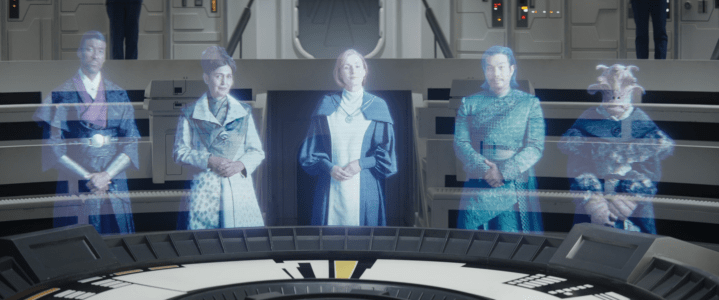
The third episode of Ahsoka contains a scene where Hera Syndulla tries to persuade New Republic Chancellor Mon Mothma, alongside several senators, to take seriously the threat of Grand Admiral Thrawn’s potential return. In a disappointing yet not at all surprising decision, the New Republic declines to give Hera the aid she seeks.
That would again happen a few decades after the events of this series, which was why Leia Organa formed the Resistance to prepare for and counter the rising threat she saw but that few others took seriously.
So why was this New Republic so hesitant to get involved? While it would be easy to dismiss them as an incompetent government, the truth is actually far more complex than that. It’s part incompetence, sure, but it’s also built on several core principles set forth by Mothma and the Republic that are quite noble in theory, but in practice leave more to be desired. Here are six reasons, in the Star Wars universe, why the New Republic government is slower to take these threats seriously – by design of the way they’ve built the new regime.
1. Mon Mothma doesn’t want to be a Chancellor like Palpatine
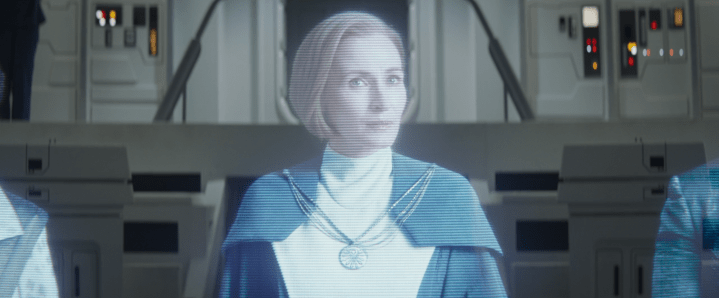
Mon Mothma was in the Republic Senate when Sheev Palpatine was elected as Chancellor, which meant she had a close view of his slowly accumulating power – accumulation that happened rapidly during the Clone Wars, as the Senate continued to vote more and more emergency powers to Palpatine. This had many people wary, including the Jedi Council and a group of senators that included Mothma. Those fears were justified when Palpatine appointed himself the Emperor of a new Galactic Empire. Mothma was a repeated political thorn in Palpatine’s side, and she sought to govern far differently than him. But when Mothma was elected the first Chancellor of the New Republic, in a twist of irony, the brand new Senate voted to give the very same emergency powers to her that Palpatine had years earlier. The rationale for this was that they were still at war, but Mothma reluctantly accepted while resolving to divest the office of Chancellor from the power it had under Palpatine.
This helps to explain what we saw play out in Ahsoka. It appeared as if Mothma was receptive to Hera’s concerns and was concerned herself, but the senators with her were not. And, right or wrong, Mothma was going to be very hesitant to go against the senators. This is nothing new. For example, in Rogue One as the Alliance debates whether to send military action to Scarif, Mothma declines since she doesn’t have the full support of the council. Or in the book Aftermath: Empire’s End, Mothma believes strongly that the Republic should send their fleet to Jakku to defeat the Empire once and for all and end the Galactic Civl War. The Senate votes her down… but she later makes another impassioned plea, and this time they vote in favor of it. The point is that for better or worse, Mon Mothma does not want to be the kind of Chancellor who wields all the power to get her own way, like Palpatine did.
2. One of the New Republic’s main messages to the galaxy is that the fighting is done
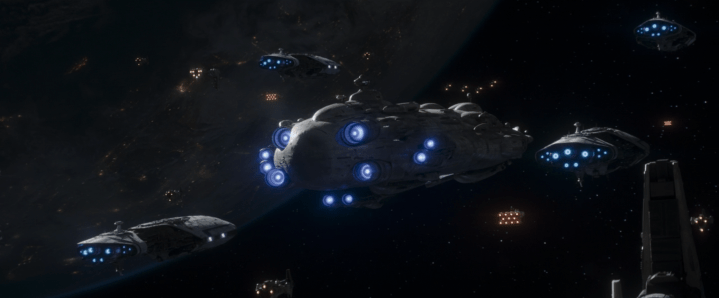
In 22 BBY (meaning 22 years before the Battle of Yavin), the galaxy was thrust into the Clone Wars, which lasted for three years until its end in 19 BBY. Less than two decades later, there was another galaxy-wide war at play, as the Galactic Civil War was declared in 2 BBY (after years of skirmishes and fighting). The war would last eight years until it ended at the Battle of Jakku in 5 ABY (after the Battle of Yavin). Ahsoka takes place approximately four years after that, which means that the galaxy has faced two massive, costly, galaxy-spanning wars in the span of the previous few decades. To say that people are weary of war would be an understatement, and that’s exactly what the senators bring up in this episode.
And this reality was actually one of the key driving points of the New Republic government as they tried to win people over. Now on their third government in three decades, many people of the galaxy were skeptical, disillusioned, indifferent. But Mothma and the Republic took intentional steps trying to send messages that they were different – and, most importantly, they were done fighting. The biggest example of this came with the passing of the Military Disarmament Act, one of the first steps taken by the New Republic Senate after the Imperial surrender with the signing of the Galactic Concordance. In the Act, the New Republic Defense Fleet was reduced by ninety percent, leaving them with the largest fleet in the galaxy but designing a fleet built on keeping the peace rather than fighting a war. Some, including most notably strong opposition from Mothma’s friend and New Republic Senator Leia Organa, thought such a move was unwise and short-sighted. But as a message to a weary galaxy, the move went a long way to winning people over and convincing them the New Republic meant what they said. In light of all this, it is understandable why the government would be far slower to get involved in another fight. It’s much like the Allies in the wake of World War 1, so tired of the fight that they prioritized avoiding another war above all else, which inadvertently allowed Hitler and Nazi Germany to rise to power.
3. The New Republic is occupied trying to run a government and aid war-torn worlds

Part of it is a matter of principle, but part of it is also a matter of what’s practical. The truth of the matter is that establishing and running a government brings with it a whole new set of challenges than fighting to overthrow a government, and Mothma and the rest of the New Republic leadership found the task far harder than they may have originally thought. It wasn’t for lack of trying, but it’s a large galaxy and there are many worlds in need of aid and assistance. This is what Senator Hamato Xiono alludes to when he tells Hera that the resources she requests could be better used elsewhere, “helping the people of our fledgling Republic.”
Putting aside the fact that Xiono isn’t exactly the kind of guy to be feigning the peoples’ good as his highest aim, his point nonetheless stands: the New Republic found that it had to ration resources and prioritize those worlds most in need, most devastated by the Empire, and most core to the Republic’s efforts. By the time this series takes place we’re less than five years removed from the war, and to see this kind of restoration and reconstruction on a galactic scale will take far more time. It means that the Republic will be more hesitant to fund a mission like the one Hera proposes, because it will be pulling resources away from somewhere else.
4. Even though Imperial remnants are out there, the New Republic tolerates it as long as it’s manageable

When the Galactic Concordance was signed alongside the Imperial Instruments of Surrender, Mothma actually didn’t push for the complete destruction of any and all Imperial forces. She declined to prosecute most Imperials (with the exception of key military officers), instead offering them amnesty. The Imperial fleet was immediately ordered to disassemble and cease, they abandoned the Imperial Academies, and they forfeited their claim on core worlds they had governed. But there were permitted boundaries within the galaxy where the Imperial Remnant could still operate, provided they followed the strict rules imposed on them. Because of the restrictions most. loyalists chose instead to retreat into the unknown regions to regather there away from New Republic rule.
But nonetheless the official surrender of the Empire, although unconditional, provided for small remnants of the fleet to remain in place under certain provisions. The key part was that they were so splintered and scattered, and under such strict terms of surrender, that they posed little threat (which, in a sense, was true, since the greater threats emerged from the unknown regions in secret). Importantly, though, this explains why the mere presence of Imperial loyalists isn’t an utter shock to the New Republic leadership. Mothma and the senators know that there are Imperial remnants out there; they just don’t think it’s anywhere big enough to pose a problem to their government. And they’re right… unless someone like Thrawn would lead them. That’s why one of the senators tells Hera, “I see no enemy. The Imperial fleet is scattered and broken. They have no centralized command.” In other words: we know they’re there, but they’re no threat to us. Which is why Hera responds by saying, “unless Thrawn returns.” The New Republic doesn’t take seriously the threat because of how scattered the remaining Imperial fleet is… but it’s exactly why the threat of a formidable military leader who could rally them together should be cause for concern.
5. The New Republic failed to recognize the lingering impact of the Empire within (and outside) of their ranks

Finally, there’s the reality that the New Republic simply didn’t realize how strong the lingering loyalties to the Empire were. When Mothma accepted the Empire’s surrender, she also sought to help those who fought for the Empire integrate into the new regime in healthy ways. This led to the creation of the New Republic Amnesty Program, seen in The Mandalorian, where the Republic took former Imperials and sought to rehabilitate them into productive members of society. Rather than prosecuting every soldier who fought for the Empire, the New Republic only prosecuted officers, and even then offered select pardons for certain people. This was a noble intention that helped the galaxy move on from the war much quicker, but it also allowed some of these ideals to linger. Think, for example, of how after the United States won the Civil War they didn’t prosecute everyone who fought for the Confederate Army; this brought about much good for the recovery and re-unity of the country, but it also allowed racist attitudes to linger. The New Republic seemed to underestimate how much Imperial loyalty would linger.
When Hera tells the council that there were people loyal to the Empire working at the Corellian shipyards, one of the senators quickly dismisses them as “outliers.” There’s an inherent assumption that this group must be so small, so radical, that they pose no threat. They didn’t wrestle with the very real possibility that there was still a substantial number of people (albeit a minority) who were loyal to Imperial ideals within the Republic, and more growing in secret beyond it. Probably from a bit of arrogance and hubris, the New Republic thought that surely the threat wasn’t that big.
They would continue to think that until the First Order destroyed the Hosnian System, and the New Republic Defense Fleet, with Starkiller Base. But by that point it was too late for the Republic, and the only force remaining in-between the First Order and a resurgent Empire was Leia Organa’s Resistance.
6. There were some who viewed Hera’s concerns about Thrawn as biased and unreliable

There is one more factor worth briefly mentioning, although this one doesn’t have to do with the New Republic at large. It’s instead a specific reason why Hera’s quest isn’t listened to like we might imagine it would (or should) be: they think she’s biased by her quest to find Ezra Bridger. That’s precisely what Hamato Xiono accuses her of, seeing this as just another attempt to get resources to try to find Bridger. Since Ezra and Thrawn disappeared together, raising alarm about the threat of Thrawn is a clever ploy to get more resources to find Ezra too. It’s like the story of the boy who cried wolf.
But what’s interesting about this is it implies that Hera hasn’t given up the search for Ezra, but in the first episode was nonetheless surprised to learn he might have survived. Perhaps she had begun to give up hope, but that doesn’t mean she has always been there. It does make sense why Xiono would be skeptical about Hera’s bringing up Thrawn, but that needn’t be a reason to keep the New Republic as a whole from investigating. However, what this brings up is that there are personal dynamics at play in all of this too. These issues aren’t disconnected from real people, real relationships, and real stories that impact their decision-making.
 Star Wars Thoughts