
The moment we’ve been waiting for has arrived, as Ahsoka premiered on Disney+ on Tuesday night with a two-episode debut. And, in short, it’s a dream come true.
The series had two episodes that dropped tonight, with episode one titled “Master and Apprentice” and directed by creator and showrunner Dave Filoni, while episode two was titled “Toil and Trouble” and directed by Steph Green. The episodes go together to provide a terrific introduction to this eight-episode show, one that follows after so many epic Star Wars shows before it and lives up to every bit of that hype.
Let’s dive in to our review, but there are full spoilers ahead. So proceed with caution if you haven’t seen the episodes yet.
This show is such a surreal experience for me. Rebels is my all-time favorite Star Wars show, and a number of Ahsoka’s characters – like Ahsoka Tano, Sabine Wren, Hera Syndulla, and Grand Admiral Thrawn – are among my all-time favorite Star Wars characters. To see this series playing out on the screen, much less in live action, is incredible. We’ve been waiting for many years to see the sequel to Rebels that we always assumed would be coming, and it’s a pure delight to see it playing out.
And these first two episodes are simply terrific. It’s the most Star Wars has felt like a movie since Dave Filoni’s Siege of Mandalore arc of The Clone Wars in 2020, and I don’t even think there’s a close comparison to anything else since. This series begins with an opening crawl setting the stage, then jumps right into an opening sequence that is so well done. The visuals and production quality of this series reflect significant care and attention, and seems to mark a significant step up when compared to some of the other Disney+ shows (and that’s especially true when it comes to the lightsabers). There’s a lot of care and intentionality put into every piece of this project.
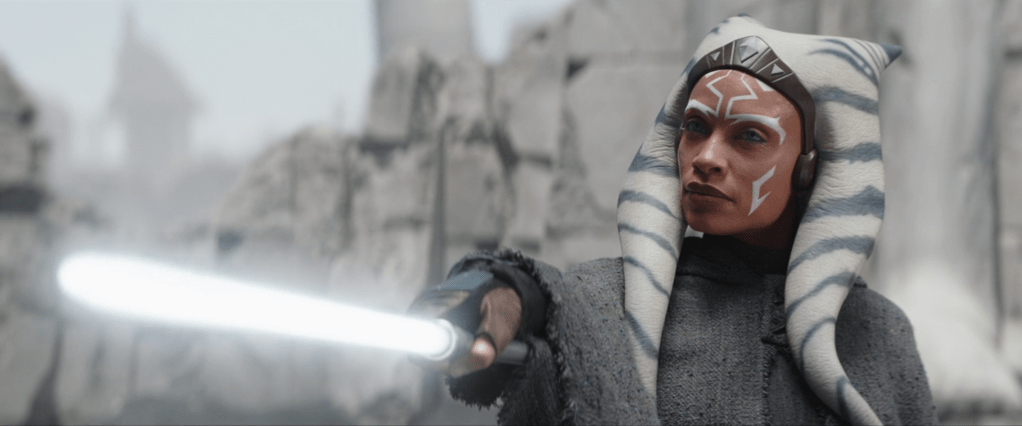
But the most important piece that was going to make or break it was the casting, as it’s an incredibly difficult task to translate characters beloved in animation to live action. Rosario Dawson won me over with her episode in The Mandalorian, and while she’s a more stoic and reserved version of Ahsoka than her animated version, that’s easily explained story-wise given how many years have passed since those other stories – this is set well over a decade after anything we’ve seen of Ahsoka in animation. I loved the puzzle-solving scene that introduced her, taking a page right out of the Star Wars Jedi playbook – and later, too, when Ahsoka could sense echoes of what had happened in places, just like Cal Kestis can. I thought those were cool nods.
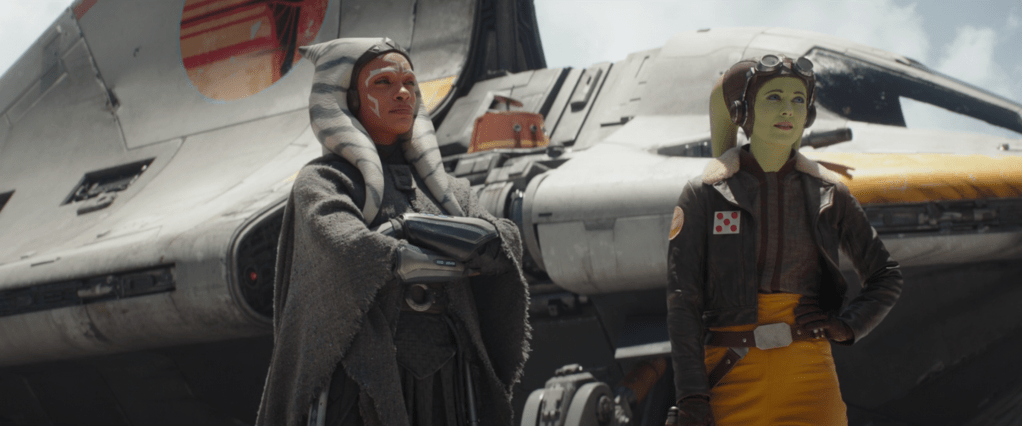
While we’d already seen Dawson a few times as Ahsoka, we’ve now seen Mary Elizabeth Winstead as Hera Syndulla, and I thought she captured the character very well. Hera was involved very heavily in these opening episodes, which I loved, and she continued to play the role of a wise and caring mentor, especially her touching scene with Sabine. And the sequence of Hera piloting the Phantom in pursuit of the fleeing ship, all while bantering with Chopper, was perfect. And speaking of perfect, Chopper! He’s still a blood-thirsty war criminal with a sassy attitude but a droid you can count on to get the job done, and everything we loved about him in Rebels shows up here.
It was terrific seeing all these characters on screen in live-action, but the unquestionable highlight of these episodes was Natasha Liu Bordizzo’s performance as Sabine Wren. It’s an example of perfect casting, and Sabine’s arc in these two episodes was driving so much of it. We pick up the story well after Rebels has left off, and the show does a decent enough job of filling in the important details. I’m still curious to know how well fans will track and engage if they haven’t seen the animated shows, but I think more or less the basics are there. After what we saw in Rebels, Ahsoka began training Sabine to be a Jedi, but at some point Ahsoka walked away from her. We don’t know the full reasoning behind it, but we do know that Sabine feels like Ahsoka abandoned her. I think we could put a few pieces together to perhaps come up with at least some reasonable speculation: Ahsoka fears the attachments that, in her mind, led Anakin to the dark side. So when Sabine asks her where her home is, Ahsoka says it’s this ship – she’s living a nomadic lifestyle, not staying anywhere too long. She refused to train Grogu in The Mandalorian because he was too attached to Din Djarin. Might she have refused to keep training Sabine for the same reasons, given her attachment to her friends? Maybe we’ll learn that this speculation is way off, but I do wonder if we’ll see this as part of Ahsoka’s journey in this show. Regardless, her and Sabine aren’t exactly on the best of terms when they pick things up here, but it’s Hera who prompts their reunion. Ahsoka has begun hearing whispers of Thrawn’s return, which led her to investigate by pursuing Morgan Elsbeth (which is what we saw in The Mandalorian). Elsbeth gave her the information needed to find a map that’s supposedly key to finding Thrawn, as it leads to another galaxy.

Seeing Hera’s reaction to learning that Thrawn – and therefore Ezra – might still be alive was a cool moment, but Sabine is needed to decipher the code. She does, but the villains get to her before she can do anything with it. Let’s pause here and note that Ray Stevenson and Ivanna Sakhno both nail their roles as well (and how sweet was it to have the first episode dedicated to Stevenson!) and I absolutely can’t wait to see and learn more. These episodes contained plenty of lightsaber combat – something we’ve seen sparingly in recent years – and it was all really well done. I loved seeing Sabine duel Shin Hati, and it was apparent both that she was capable but also that she was rusty and out of practice. Sabine’s training has not yet been completed.
But Ahsoka remains hesitant to continue it, especially out of her frustration with Sabine losing the map to the villains. Sabine is able to give them a lead on them, however, by sending them to Corellia. There we get a reminder that the New Republic found governing far harder than winning a war; Corellia was a former Imperial shipyard (where Morgan Elsbeth held significant sway) but was supposedly under New Republic control by now. But as we come to learn, the former Imperials are still somewhat loyal to the Empire – or, at least, to greed, as Ahsoka says. We saw this show up in the third season of The Mandalorian, as the New Republic Amnesty Program gave former Imperials a chance to work for the New Republic, but in this instance it leaves them open to corruption from the inside. These workers on Corellia have secretly been aiding Morgan Elsbeth’s efforts, supplying her with massive hyperdrive engines for the Eye of Scion, which I presume is a giant hyperspace ring capable of traveling to another galaxy to find Thrawn.
Speaking of Elsbeth, the speculation was right: she is in fact a Nightsister, having survived the destruction of her people. This adds yet another Force-sensitive player to the board, and both of these episodes really play up how significant she is to the whole quest. We knew she was an old ally of Thrawn’s, and given her influence on a shipbuilding world like Corellia I wonder whether part of that partnership during the days of the Empire was thanks to Thrawn’s pursuit of his TIE Defender project, which would require parts for hyperdrives and shields and the like. Regardless, it seems that Elsbeth is going to be a cunning foe not to be underestimated.
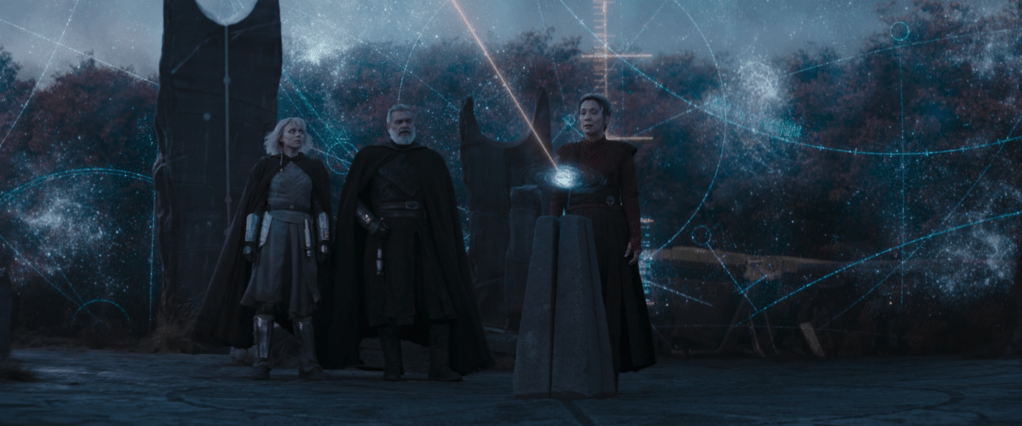
On Corellia, Ahsoka and Hera (and don’t forget Chopper) spring into the fight, trying to stop the enemy from making off with the hyperdrive. They’re unsuccessful, but Chopper does put a tracking beacon aboard the ship – and by the end of the episode, they have a location. Even more importantly, though, is that Sabine Wren is ready to resume her training. She puts her Mandalorian armor back on, cuts her hair, and let’s Ahsoka know she’s ready. The second episode draws near to a close with the epilogue of Rebels, with Sabine standing by the mural before greeting Ahsoka, who has arrived to pick her up. Everything about the scene from Sabine’s standpoint is so close you’d be forgiven for thinking it was just copied and pasted. One notable change has been made for Ahsoka, though, as she wears her gray robes in this episode rather than the white ones we see in Rebels. I think that’s a change easily forgiven, because I think part of this series is going to be Ahsoka’s journey from “Ahsoka the Gray” to “Ahsoka the White” as she grows along the way, much like Gandalf in The Lord of the Rings (who has long been one of Dave Filoni’s top inspirations for Ahsoka). That will make for a far better story in the long run, I’m sure.
These two episodes were deliberately paced and willing to take their time setting the stage, doing a ton of heavy lifting to introduce these familiar characters to new and old audiences, and I think it’s something done very well. There are some really fun cameos – like Ryder Azadi, Jai Kell, and Home One – that die-hard fans will catch, but these cameos aren’t essential to the story. The background info that is essential seems to more or less be addressed. Also, as I mentioned earlier, this really does feel so much like a Star Wars film, far more so than any other Disney+ show the franchise has done to date. That’s not a knock on those shows, which have been enjoyable, but they’ve been trying to do different things. Some of them have leaned heavily into the serialized “story of the week” type format conducive to TV, which is great. Others have told a cinematic story, but doing so in a way that the production quality felt a bit lesser than the films. But Ahsoka seems to pull all of it together, and it feels so much like pure Star Wars – which shouldn’t be a surprise, since I’ve long argued that Dave Filoni understands the themes of the franchise as well as anyone else. The story is fun, a mix of lighthearted moments and heavy emotion and stakes, with great performances, intriguing lore, mysterious investigations, exciting action, gorgeous visuals, and an epic score.
Speaking of which, Kevin Kiner deserves MASSIVE praise for his work in these two episodes. This is his first live-action Star Wars score, but he’s certainly no stranger to the franchise, having worked with Dave Filoni and company to provide the score for The Clone Wars, Rebels, The Bad Batch, and Tales of the Jedi. Through this work, Kiner has composed some of the very best character themes in the entire Star Wars universe – an especially impressive feat considering John Williams’s legendary motifs. Ahsoka’s theme, Sabine’s theme, and Thrawn’s theme are all among my favorites, while Ezra’s theme and Hera’s theme are worthy of praise too. But these two episodes might be Kiner’s best work yet, because of the way he’s able to weave all of these familiar themes together into something so beautifully emotional yet fresh. At several different poitns I got emotional hearing Ahsoka’s theme and Sabine’s theme, and I loved how there were some faint hints of Thrawn’s theme sprinkled in as a sort of foreshadowing – the theme isn’t complete right now, because Thrawn is still missing, but he’s coming. This score helped drive the feeling that this fits right along with a Star Wars film, as it sounds so much like classic John Williams stuff. It’s inspired by that, but it’s actually classic Kevin Kiner stuff, which is some of the best Star Wars music we’ve ever gotten. Right from the very start of the first episode it was clear that Kiner’s score was epic, and the end credits score might be my favorite piece he’s ever done. Music has always been so key to Star Wars, and this score blew me away, as I figured it would with Kiner doing it.
Overall, these episodes were a beautiful sequel to Star Wars Rebels, tying together stories and characters in a new period, a new medium, and for new audiences to tell a story that is off to a terrific start.
 Star Wars Thoughts