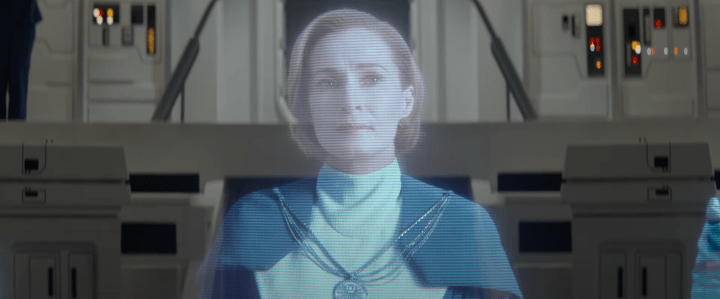
The rebellion overthrew an Empire… but then they had to establish a new galactic government. And that’s not an easy task.
The new Star Wars canon has been exploring the ways the New Republic that was formed in the aftermath of the Empire, for all it’s best intentions, didn’t get it all right. Those stories started in publishing, but they’re now making their way to the screen. The Mandalorian‘s third season showed the frustrations of the bureaucratic process and it’s shortcomings. From the looks of it, Ahsoka will continue that theme by introducing a major character into the post-Endor world: Mon Mothma, the Supreme Chancellor of the New Republic.
In the recently released trailer for Ahsoka, General Hera Syndulla speaks with Chancellor Mon Mothma, saying, “I’ve spent most of my life fighting a war. That’s why I’m trying to convince you to help me prevent another one.” It seems quite likely that the New Republic won’t give the help needed, leaving Hera, Ahsoka, and Sabine to counter the rising threat of Grand Admiral Thrawn’s imminent return by themselves.
There’s no denying the fact that the New Republic didn’t get everything right, and that some of Mon Mothma’s decisions did in fact set the stage for the First Order’s rise three decades later. But let me also make the case that Mothma’s leadership was better than she gets credit for and that her decisions are entirely understandable in-universe.
After all, it’s not just Hera who’s spent her life fighting a war. She was a Senator representing her homeworld of Chandrila by the time she was just 16 years old, and a decade later the the Galactic Republic was embroiled in the Clone Wars. As the war went on, Mothma found herself at the center of a rising resistance movement pushing back against what she viewed as too much power being centralized with Supreme Chancellor Palpatine – fears that, it turned out, were justified. Alongside Senators and friends like Padmé Amidala of Naboo and Bail Organa of Alderaan, Mothma was a consistently outspoken advocate for peace, and at a critical juncture she also spoke out against increased spending on the military to fuel the war efforts. In the waning days of the war, she was part of an extremely secretive meeting (including Amidala and Organa) that bordered on sedition as they discussed their distrust for Palpatine, and it planted the seeds for an ensuing rebellion.

As the Republic fell and the Empire was established, this rebellion mostly happened behind-the-scenes and in disorganized outbursts – but all along, Mothma continued to resist. Playing both sides, the Imperial Senator worked to secretly fuel rebel operations to undermine Palpatine and his Empire, even at great personal risk and cost. She was a continual thorn in Palpatine’s side but didn’t let on her true intentions until 2 BBY, 17 years after the Empire’s rise. Having had enough of a secret war behind the scenes, Mothma went public with a scathing rebuke of the Empire’s atrocities with the Ghorman Massacre. She resigned her seat in the Senate, and she became public enemy number one for the Empire. Mothma used the moment to pull the various rebel cells and factions together, officially uniting them together as the Alliance to Restore the Republic (more commonly known as the Rebel Alliance). This growing effort attracted various people from across the galaxy and brought them into the fight, with Mothma serving as it’s leader and commander-in-chief, coordinating a massive rebellion that escalated to open warfare. The Galactic Civil War endured for several years, but after the Rebellion’s victory at the Battle of Endor the Alliance to Restore the Republic re-organized into the New Republic.
Mothma became the first Chancellor of this New Republic and continued to command the rebellion’s fight against the Empire while working to establish the new government. The Civil War would last one year after Endor, and during that time Mothma was seriously injured in an assassination plot from Imperial terrorists. She recovered, though, and a year after Endor the New Republic finally had victory: after the Battle of Jakku, the rebels declared victory and accepted surrender from the Imperial remnants. Mothma continued to serve as Chancellor of the New Republic for a while, but by 28 ABY (23 years after the Battle of Jakku) she had retired due to her health. She was a continued ally of Leia Organa, and she was still respected. That respect had helped her hold the New Republic government together, but her successors had trouble doing the same, which accelerated the rise of the First Order.
There were a few key decisions that Mothma made very soon after the New Republic was launched, and understanding all of this background helps us understand why she made them. In a bit of irony, Mothma was given the same emergency powers by the New Republic Senate that Palpatine had been given years earlier, since the Senate thought she needed those powers in the continuing war. She was hesitant to accept it, and that’s because much of her leadership was aimed at correcting the errors she saw the Republic fall into previously. She wanted to correct those and win over a war-weary galaxy with a peaceful transition.

Thus one of her first moves was to begin working toward the Military Disarmament Act, which would reduce the New Republic Defense Fleet by ninety percent. Mothma’s intention in proposing this was to send a clear message to the galaxy that the fighting was done, and the New Republic Senate ratified the act shortly after the war ended. Mothma wanted to divest her office of the supreme powers that she had been given, like Palpatine, and wanted the military to be reduced as a symbol to the galaxy. The New Republic would still retain the largest military fleet in the galaxy, but it would be significantly smaller than it had been.
Furthermore, the Galactic Concordance was signed, a historic peace treaty reached between Mothma and Imperial Grand Vizier Mas Amedda that officially brought an end to the Civil War. This was the official surrender of the Empire, and it disbanded and eliminated any remaining pockets of Imperial power. But Mothma chose not to prosecute the Imperials as war criminals unless they had committed especially egregious crimes or persisted in them after the treaty was signed. Instead, the remnants were relegated to the outer reaches, and the New Republic Amnesty Program created a second chance for Imperials by rehabilitating them and putting them to work for the new government.
Another key move was to de-centralize the New Republic government. The Senate was first convened on Chandrila, Mothma’s home, but from the very beginning she made a conscious decision to have the seat of power rotate. She wanted the galaxy to see that this wasn’t a repeat of the previous government(s) and their rule on Coruscant, but that this was a government for the people, of the people. So the Senate was first on Chandrila, for example, but by the time of the First Order’s rise it was on Hosnian Prime.
All of this, and more, was part of a concerted effort on Mothma’s part to lead the galaxy into a new and brighter future than they had previously had, after decades of war. While it’s easy for us to look in on it and, since we know about the First Order, say it was a mistake, Mothma was always one who pushed for peace, and she (and the galaxy) had lived through two massive galaxy-wide wars in two decades. The Galactic Republic had failed and fallen, and the Empire was a tyrannical regime of oppression. Mothma sought to send a clear message to the galaxy that this New Republic was about peace, not war. They were about moving into the future, not dwelling on the past. They were about diversifying power, not centralizing it.
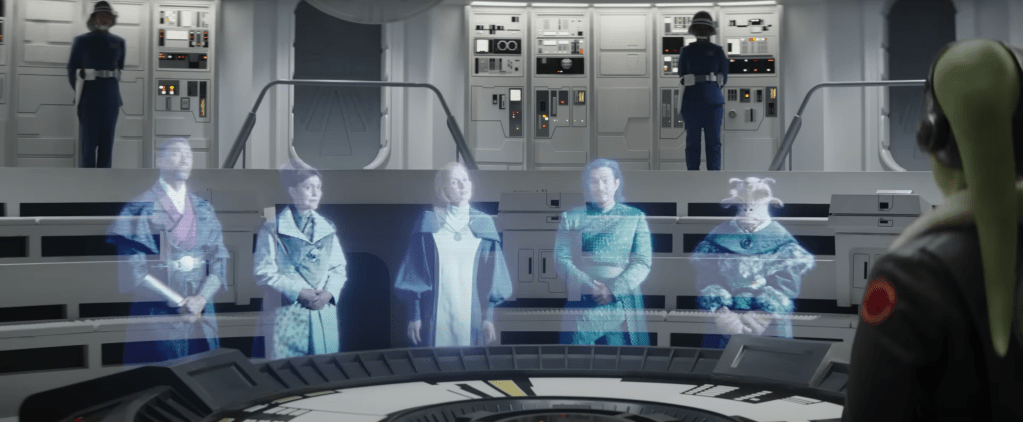
That doesn’t mean that she made the right decisions. I think in the long run, we see how it was probably short-sighted. Even some of her closest allies and supporters thought so at the time, too, as Leia Organa, Han Solo, and Lando Calrissian all seemed to be against military disarmament. Leia in particular made as much known to Mothma and advocated against it. But what is compelling is that, like many of our real-world political debates, there isn’t a clear-cut right answer to how to solve things. And there are far worse things than a leader with noble ideals trying to push for peace above fighting. Yes, in the long run, the New Republic’s decreased military and lax response to Imperial remnants spelled their doom. But that was far less clear in the moments where Mon Mothma, with the weight of a war-torn, weary, and skeptical galaxy on her shoulders, made these decisions.
So yes, I’m sure as we watch Ahsoka we’ll wish that Mothma and the New Republic were more proactive. And since we know what comes decades later we’ll have an easier time knowing what the New Republic should do. But I don’t think that should cloud our judgment of Mon Mothma’s leadership of the galaxy, because her decisions were entirely defensible given the context within which they were made.
 Star Wars Thoughts